Showing posts with label LGBT History Month. Show all posts

Monday, 24 February 2020

The Rainbow Parliament

On Wednesday Nottinghamshire Rainbow Heritage, of whom I’m a founder member (in fact it was my idea, after being approached by the Heritage Lottery Fund to help me develop my lgbt guided tours) is holding its annual celebration for LGBT History Month UK. This year I’ve been able to put together a small table-top display.

I’ve used the research I’ve done for this blog as the basis for some panels on lgbt history. One panel contains general information on local lgbt history and another is on the origins of some Christmas traditions which I featured last December. The main panel is on lgbt representation in the UK parliament. Since at least 2005 the UK has had the most openly lgbt members, in both the House of Commons and House of Lords, than any other national parliament in the world.

Rather than have a static, flat panel full of eye-numbing statistics I’ve designed a tactile, moving exhibit in the form of a rotating Big Ben clock tower (officially called the Elizabeth Tower).

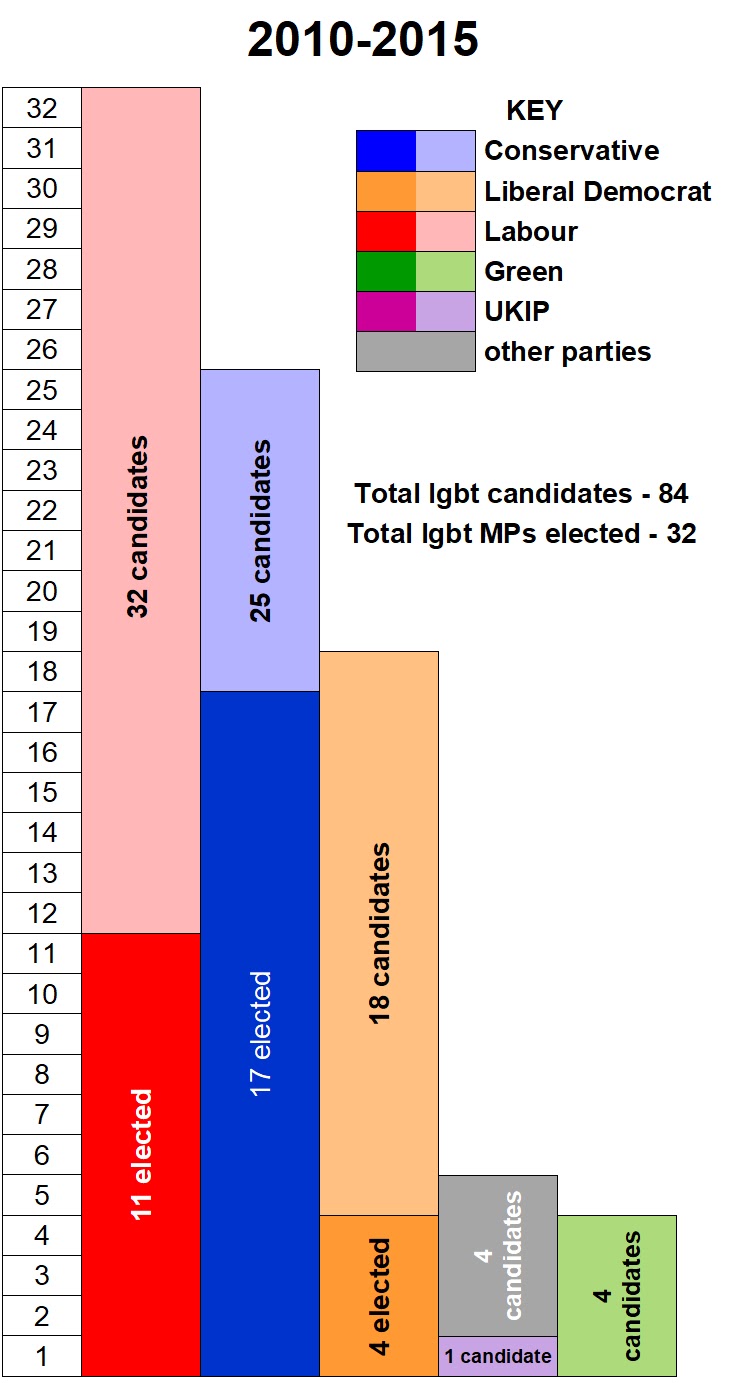
On each side of the tower is a chart showing the total known lgbt parliamentary candidates and elected MPs there have been in the current parliament and the three preceding ones. The numbers include candidates and MPs who were not out publicly at the time.

Below is a video of that exhibit and how it fits together and works. Below that are reproductions of the charts on each side. The date are those of the current and previous parliament and represent periods from the day of one general election to the eve of the next. The numbers includes MPs and candidates who have subsequently come as members of the lgbt community.
I was pleasantly surprised to discover a while back that there were actually some lgbt history tours around the Houses of Parliament themselves. I don’t think any other national parliament does this. The lgbt tour is called Pride at Parliament. It concentrates on stories and politicians connected to the current building constructed. I hope to go on one of these tours myself on one of my annual trips to London.

If you’re heading to London yourself perhaps you’ll have time to go on a Pride at Parliament tour. The tours are on specific dates so you may not be there at the right time. I’ll leave you today with a link to the tours webpage here.

Thursday, 6 February 2020

20 Queer Facts for LGBT History Month UK

Happy LGBT History Month UK. Here’s 20 more queer facts you may or may not know. Ideal for quiz questions at your History Month celebration.

1) The agamoi were unmarried Spartan men over the age of 30. The Spartans claimed they showed no interest in fathering children and spent too much time in each other’s company. Even though Spartan men followed the cultural norm of having boy lovers as well as wives they considered the agamoi to be perverted because they didn’t have wives as well. Because of this the agamoi were banned from attending the regular naked sport festivals, but were allowed to compete in their own – in the middle of winter, also naked.

2) L. Craig Schoonmaker (1944-2018), the person who first came up with the term “gay pride”, ran for President of the USA in 2000 as an independent candidate.

3) “Star Trek” legend and lgbt activist George Takei (b.1937) is also an athlete. He joined the Los Angeles Frontrunners (an lgbt athletics club) before he came out publicly in 2005. In 2006 he won a gold medal at the Gay Games in Chicago in the 4x100 meters relay. His team was called the Trekeys.

4) Openly lesbian British Olympic BMX cyclist Shanaze Reade (b.1988) entered the Guinness Book of World Records live on British television on 28th March 2016. She became the fastest person to cycle round a “Wall of Death” at a speed of 26.8 miles an hour.

5) A cinaedus was a male dancer in the Roman Empire who twerked! The erotically-charged shaking of the back side during the dance led to the association of that name cinaedus with passive sexual male partners.

6) The world’s first ever variety/light entertainment programme on television was “Looking In” on the BBC on 23rd April 1933. It was produced by Eustace Robb (1899-1985) who went on to produce one variety programme a week for a year. He was an openly gay ex-army officer who lived on a country estate in Oxfordshire where the Duke and Duchess of Sussex once rented a house until hounded out by paparazzi.

7) In the 2nd century BC King Alexander Balas of the Seleucid Empire (modern Turkey, Syria, Iran, Iraq, Afghanistan and bits of Pakistan) consulted an oracle who told him to “beware of the place that bore the two-formed one”. Alexander was later assassinated in Abrae in Greece. Abrae was the home of a male warrior called Diophantus, who had been born female.

8) In 2011 Dr. Bryan Lessard (b.1988), an openly gay entomologist, named a species of fly Scaptia beyonceae after the singer BeyoncĂ© because it has a prominent “bootylicious” rear end. Bryan is something of a celebrity in entomology circles and is known as “Bry the Fly Guy”. He works at the Commonwealth Scientific and Industrial Organisation in Sydney, Australia, and in 2019 organised a group of colleagues to take part in the Sydney Gay and Lesbian Mardi Gras parade.

9) Fans of the 1980s series “Man from Atlantis” may like to know that the majority of the underwater swimming scenes were not done by the show’s star, Patrick Duffy, but by an openly gay, national swimming champion called Tom Reudy (b.1955). Tom has also won over a dozen medals at the Gay Games since 1986.

10) The Byzantine Empire created several high-ranking and influential positions at court for eunuchs. These eunuchs could be either castrated men (called ektomiai) or naturally-born intersex (called spadones, or thladai). There were even noble ranks created for them. Several of them became Patriarchs, heads of the Greek Orthodox Christian Church, equivalent to an archbishop.

11) The famous line “Me Tarzan, you Jane” from the iconic 1932 film “Tarzan the Ape Man” starring Johnny Weismuller didn’t appear in any of the 26 Tarzan books written by Edgar Rice Burroughs. It was a line created by gay songwriter Ivor Novello (1893-1951) during his short time as a scriptwriter for MGM studios.

12) Ganymede is the biggest moon in the solar system, bigger than the planet Mercury. It is one of over 70 known moons that orbit Jupiter. Those that have been named are named after sexual partners and female descendants of Jupiter/Zeus – except Ganymede. He is the only male lover of Jupiter after whom a moon is named.

13) The iconic Union Flag (or Union Jack, its makes no difference – trust me, I’m a member of the Flag Institute) is based on the original flag of the union of the thrones of England and Scotland in 1601. That original was chosen by the gay “Queen” James I who wanted a new flag to be flown from ships of the unified navy. He asked for a design which combined the flags of England and Scotland so that neither had precedence. Despite this, the finally accepted design gives the Scottish flag precedence in heraldic terms (James was Scottish), being the blue base on which the English cross is placed.

14) Figures from the Ministry of Justice of England and Wales published in November 2019 revealed that more than half of the prisons in England and Wales (62 out of 121) had at least one transgender inmate. This does not include inmates who had received a legal Gender Recognition certificate.

15) The influential queer statesman, philosopher and scientist Sir Francis Bacon, Viscount St. Alban, (1561-1626) was a pioneer in experimental research. His final experiment was to see if snow would preserve a dead chicken. Conducting the experiment on a cold and snowy Sunday in April he caught a chill and died of pneumonia three days later.

16) Despite popular belief Harvey Milk was NOT the first openly lgbt person to be elected to public office in the USA. He was, at the very least, the 4th. Nancy Wechsler and Jerry DeGriek were elected to the Ann Arbor city council in Michigan on 3rd April 1972. They both came out as lesbian and gay respectively four months later. They didn’t stand for re-election in 1974 but supported Kathy Kozachenko in her successful campaign to become the first openly lesbian elected official on 2nd April 1974. Harvey Milk wasn’t elected to public office in San Francisco until 1978.

17) Modern democracy was founded in response to the murder of a gay couple, Harmodius and Aristogeiton. They were lovers in ancient Athens during the tyranny of Hipparchus and Hippias. During the ceremonial procession at the Panathenaic Games in 514 BC they killed Hipparchus. Harmodius and Aristogeiton were then murdered by Hippias in retaliation. Hippias was then overthrown and the new rulers created the first modern democracy. They erected a statue in honour of the murdered gay couple.

18) Carl Austen-Behan (b.1972) holds an interesting combination of honours and titles. As an RAF firefighter he won a Royal Humane Society Bronze Medal for rescuing a pilot from a crashed military aircraft in 1992 (he was dismissed in 1997, when it was illegal to be gay in the RAF). In 2001 he was voted Mr Gay UK. In 2016 he became Lord Mayor of Manchester (he was host to the national service of commemoration for the Battle of the Somme centenary). In 2020 he was awarded an OBE (Officer of the Order of the British Empire) for services to charity, the lgbt community and Manchester. He was also appointed a Deputy Lieutenant of Greater Manchester by the Lord Lieutenant (the Queen’s representative).

19) Spintry is an old word for a male prostitute and gay sex. The word was used in England during the 17th century. It originates from a Greek work for a bracelet. The allusion is that a hand goes through the bracelet – I’ll leave you to guess why it became used for gay sex and prostitution.

20) Lt. Robert Jones (c.1740-after 1780) of the Royal Artillery popularised figure skating, if not even inventing the modern sport. He designed the first modern ice skate, which had the blade attached to the boot (previously blades were strapped onto ordinary walking boots). In 1772 his book “A Treatise on Skating” was published - during his trial for sodomy. He was found guilty and sentenced to death. However, King George III must have been a skating fan because he granted Jones a royal pardon – on condition he left the UK for good.

Monday, 25 February 2019

More Lgbt Olympians Than Ever

For up-to-date information on the opening day of Tokyo 2020 go here.


There’s only just over a year until the Tokyo 2020 Olympic Games kicks of with the lighting of the Olympic flame at Olympia on 15th March 2020. Here are my updated lgbt Olympian lists. I had hoped to come up with a new format but haven’t had time to come up with one. Hopefully I will by next year.

The number of lgbt Olympians still grows. On average I add 2 new names every month.

Below are the new lists. I have split the Summer and Winter games into separate lists. The Winter list also includes the known lgbt athletes who competed in Olympic trials and qualifying tournaments, plus a handful of coaches, judges and officials.

https://drive.google.com/file/d/10e6OsTkESee3vmHASoHtrCeaeLJUW2-r/view?usp=sharing

https://drive.google.com/file/d/1yqp69ce-Pzt7vxB8Nx5UcCtSVwJkNr-i/view?usp=sharing


One of the exciting prospects for Tokyo 2020 is that there could be the high probability that there will be 100 out lgbt Olympians at the same games for the first time. It is also likely, given past experience, at least 2 athletes will come out during those games.

While it is still a concern to many that there are two few openly lgbt Olympians it may be encouraging to know that there is a large number who compete in trials and qualifying tournaments who don’t perform quite good enough to be selected for their national team. To illustrate this I’ve produced the table below in which I show the total number of known lgbt athletes who aspire to Olympic selection against those who succeed.

Records of which events are official qualifying events are difficult to determine prior to 1948 so the table only includes statistics from the 1956 Melbourne Summer Olympics onwards where events are specifically designated as an Olympic qualification event. I’ve not included the 1980 Moscow Olympics because of the boycott by many athletes making it even more difficult to determine who would have been there.

Bear in mind that the number in the Trials column are those who competed in trials and qualifying events but were not selected for the Olympics. For the complete total of lgbt athletes just add the Trials and Olympics figures together. For example, 6 lgbt athletes competed in the trials, etc., for the 1956 Melbourne games but only 3 were selected and competed at the games while 3 weren't.

Season
Games
Trials
Olympics
Total
Summer
1956 Melbourne
3
3
6
Winter
1964 Innsbruck
4
1
5
winter
1968 Grenoble
5
2
7
summer
1968 Mexico City
1
6
7
winter
1972 Sapporo
1
3
4
summer
1972 Munich
2
6
8
winter
1976 Innsbruck
0
4
4
summer
1976 Montréal
2
10
12
winter
1980 Lake Placid
2
3
5
winter
1984 Sarajevo
8
6
14
summer
1984 Los Angeles
4
13
17
winter
1988 Calgary
6
9
15
summer
1988 Seoul
1
22
23
winter
1992 Albertville
5
5
10
summer
1992 Barcelona
3
21
24
winter
1994 Lillehammer
7
5
12
summer
1996 Atlanta
8
27
35
winter
1998 Nagano
17
9
26
summer
2000 Sydney
7
64
71
winter
2002 Salt Lake City
15
14
29
summer
2004 Athens
9
46
55
winter
2006 Turin
20
21
41
summer
2008 Beijing
24
64
88
winter
2010 Vancouver
14
26
40
summer
2012 London
35
74
109
winter
2014 Sochi
15
26
41
summer
2016 Rio de Janeiro
39
84
123
winter
2018 PyeongChang
10
18
28

Looking at the figures there are some interesting conclusions to make. First of all, we can see that the number of lgbt athletes has already exceeded 100 if we take into account those who competed in trials, with London 2012 taking us to 109. Secondly we have to rake into account that the number of athletes of all sexualities vastly outnumbers the one who made it onto their national Olympic team. In sports such as swimming or track and field there could be hundreds of competitors in the national trials, particularly in the USA, and only 3 spaces available for the same Olympic event.

This in itself gives us a more optimistic overview of lgbt athletes. Look at the figures for the 1976 Innsbruck Winter Games. There were only 4 known lgbt athletes at the games, all of whom competed in the trials. That’s a 100% success rate, however small the number.

In terms of success it is gratifying to know that in most cases the number of lgbt athletes who competed at an Olympic games outnumbers the lgbt athletes who didn’t. But don’t forget, the same is true with non-lgbt athletes.

If we need to decide which Olympics can be considered as the best with regard to lgbt conclusion (in terms of numbers rather than percentage) then it has to be Sydney 2000. Of the 71 known athletes who competed in the trials and qualifiers only 7 didn’t make it to Sydney. That’s a lower number but a higher percentage than either London 2012 or Rio 2016 where over 100 competed in trials.


If you study the figures more closely I’m sure you’ll find something that reveals positive trends that are hidden underneath the official Olympic numbers.

I hope you find these tables and charts of interest, and bear in mind that ongoing research could easily make them out of date within a month!

That’s it for LGBT History Month UK. I’ll be back in April with another month of lgbt heritage, which will include an article to celebrate the 10th anniversary of the Mr. Gay World contest, the 600th anniversary of the death of Leonardo da Vince, and a look at one of the darkest and most far-reaching legacies that a member of the lgbt community has ever produced.