Showing posts with label politics. Show all posts

Thursday, 8 July 2021

William and John: Part 3) William at Court

After looking at Sir John Clanvowe’s military career we turn today to the court career of his partner, Sir William Neville.

First of all, let’s look at Sir William’s marriage. It wasn’t what you could call a “marriage of convenience” as it might have been described in the 20th century, in which a marriage was arranged to hide the sexuality of one of the partners. Men we would regard as gay today would often marry and have children in pre-modern times. They didn’t think there was anything was wrong with that.

Sir William’s marriage was more of a political and financial marriage. As I mentioned in Part 1 when I described the childhoods of Sir William Neville and his male partner, William had little chance of inheriting substantial property or an income from his father, being the youngest of five sons. After plans for William to inherit the estates of his step-brother, Lord Greystoke, fell through, Lord Neville arranged for him to marry the heiress of manors spread across Yorkshire.

In 1366 William married Elizabeth le Waleys, the younger of the two daughters and coheirs of Stephen le Waleys, 2nd Baron Waleys. The elder daughter, Anora, died childless within two years and Elizabeth became sole heir to the family estates and "de facto" Baroness Waleys. This meant that William Neville now had an independent income and property through his wife (all property of a married woman usually belonged to the husband in those days). Elizabeth le Waleys was as well connected as her husband. Her father’s step-brother was the famous Robert the Bruce, King of the Scots.

As mentioned in part 2, Sir William Neville spent some time in France serving with the army during the Hundred Years War. When he returned to England he began a distinguished career at court. By this time his eldest brother Lord Neville, who had inherited their father’s title, had obtained the position of Lord Steward of the King's Household in late 1371. Probably through his brother's influence, Sir William succeeded his brother as Admiral of the North in 1372. This was one of the top naval commands in England. As Admiral of the North Sir William was responsible for all the fleet and ports north of the River Thames and naval activities in the North Sea.

In 1373 Sir William temporarily commanded the southern fleet that was appointed to patrol the Norman and Breton coasts and protect the English possessions there. Sir William anchored his fleet at St. Malo for several months and then he was called upon to go to the aid of his brother, Lord Neville. Lord Neville had been appointed ambassador to Brittany in June 1372 in order to negotiate an Anglo-Breton alliance. Brittany was subject to the French crown even though it was English support that had put the Duke of Brittany in power, as explained last time. The resulting alliance, not welcomed by the Breton lords, led to renewed rivalry between England and France. Lord Neville was appointed Captain of Brest and was given command of an English force. The French, under Bertrand du Guesclin, invaded Brittany and laid siege to Brest Castle. Lord Neville was accused of not providing sufficient military defence which led to the siege. This would taint Lord Neville’s reputation and be used against him three years later.

Lord Neville hoped that the army being assembled by Prince John of Gaunt, destined to form the "Grand Chevauchée" (see Part 2), would come to his aid. The army helped to keep the French at bay only temporarily. Sir William Neville's fleet carried an army which reinforced and restocked the Brest garrison. The Grand Chevauchée distracted some French forces away from Brest, but several other garrisons were still taken from the English.

By 1376 the war with France was not going well and people were putting some blame onto Lord Neville. As Lord Steward of the King’s Household he was also accused of helping the Lord Chamberlain to embezzle public funds. Later that year both the Lord Chamberlain and Lord Neville were impeached by parliament, even though the actual evidence of embezzlement against Neville was flimsy to say the least. This “Good” Parliament, as is it known, was called to address the many growing suspicions of corruption among the chief ministers of the old and frail King Edward III. The "Good" Parliament only deepened divisions, both at court and in the country. Sir William Neville seems to have escaped any suggestion that he profited from his brother's alleged actions. However, he was removed from his appointment of Admiral of the North in the same month as the impeachment. It wasn't long, however, before Lord Neville was reappointed Lord Steward by Prince John of Gaunt, who had by now become the chief minister of the country.

King Edward III died on 21st June 1377. His grandson Richard, Prince of Wales, succeeded as King Richard II at the age of 10. Sir William Neville had been appointed to the household of Richard just six months earlier. The succession of a 10-year-old boy as king led to politicians and royal relatives vying to ensure that the king's voice was theirs. Richard's own voice on matters was hardly ever heard, but he was personally responsible for the decision to keep Sir William Neville in his service after his accession, perhaps even making him a Gentleman of the Chamber at that time also.

By 1378 both Sir William Neville and Sir John Clanvowe were favoured members of King Richard's court. Both were King's Knights and in regular attendance on Richard. They had become members of an inner circle of friends which the young king gathered around himself. Their positions of trust was recognised by their additional appointments as Knights of the Chamber by 1381. This brought them even closer to the king than the Privy Council and indicates how much King Richard must have trusted in their confidence.

A few historians believe that by this time Sir William and Sir John had formed a close personal bond. On John's return from the French wars they would have had ample opportunity to meet at court. As the years passed their names appear together in court records more and more often, and chroniclers of their time even begin to acknowledge an unusually close bond between them. They continued to have their separate lives and appointments; Sir William and his wife Elizabeth with their estates in Yorkshire and Nottinghamshire, and Sir John with his appointments in Herefordshire and the Welsh borders. But they always managed to be together at court sessions and as the King’s Knights of the Chamber, which would be for six weeks at a time on a regular basis.

During their time at King Richard’s court they would have mingled with the other courtiers, and that included the famous poet Geoffrey Chaucer. He became a close friend of both Sir William Neville and Sir John Clanvowe. It was through this friendship that Chaucer and Sir John came up with the idea of St. Valentine’s Day as a day of romance, something that had not happened in history before. The story of how they created it is told here.

It was also at about this time that Sir William Neville acquired his connection to Nottingham Castle and Sherwood Forest. In Part 4 I’ll delve further into their time in Nottingham and how I believe Sir John Clanvowe came up with the oldest surviving ballad featuring a hero well-known across England at the time – Robin Hood.

Saturday, 29 May 2021

Homohoax: Politics, Pizza and Ping-Pong

(Homohoax: A hoax, prank, scam, confidence trick, deception or fraud committed by, targeted at, attributed to or significantly involving members of the lgbt community.)

If you were in the US during the 20216 Presidential Election campaigns you’ll probably remember Pizzagate. What you may have forgotten, or were not made aware of, is that a gay-owned business was caught up in its epicentre. You might have thought that it was all over with, but you’d be wrong. Like the anchovies on a pizza Pizzagate keeps returning.

Let’s start at the beginning. The 2016 Presidential Election was between Donald Trump and Hillary Clinton.

In October 2016 Wikileaks began publishing the hacked emails of John Podesta, Chair of Hillary Clinton’s presidential campaign and former White House Chief of Staff. Some people, mainly far-right activists, read them and claimed they contained code words for paedophilia and child abuse. Their claims were later posted on fake new websites and spread by Trump supporters and this created the “Pizzagate” conspiracy theory.

But what has it got to do with pizzas? Someone on the social media forum 4chan spotted references in the emails to going out for a pizza, and for some unexplained reason claimed the word “cheese pizza” was code for “child pornography” (c.p.). Several Wikileaks emails mentioned a gay man called James Alefantis, the owner of a Washington DC pizza restaurant and bar called Comet Ping Pong (hence “Pizzagate”). James knew John Podesta’s brother Tony, who had eaten at the restaurant.

From this the 4chan user claimed that the restaurant was the location of a child pornography ring that included senior figures in the Democratic Party associated with Clinton’s presidential campaign. James Alefantis was also the ex-boyfriend of David Brock, a journalist and social commentator and a prominent Hillary Clinton supporter in the media, dragging Clinton even further into the alleged child trafficking ring.

A Reddit user posted a document alleging proof of child sex abuse, inferring that everyone associated with Comet Ping Pong - staff, customers and guest performers - were involved in sex with minors and that performers generated “cultish imagery of disembodiment, blood, beheadings, sex”. It’s no surprise that any mention of sex is guaranteed to get people’s attention and the story was soon picked up by the mainstream media and alt-right activists.

As Pizzagate got bigger so did the lies. It even got to a stage where people pointed to a t-shirt James Alefantis was seen wearing that read “I (heart) l’Enfant”. Twisting James’s name to Jim Alefantis, then to the similar sounding phrase “Je t’aime l’enfants” (“I like children” in French) and finally to “I (heart) l’Enfant” the Pizzagate theorists claimed it was Alefantis’s coded admission to his paedophile activities. In fact, “I (heart) l’Enfant” referred to a bar in Washington named after the city’s 18th century planner, Pierre l’Enfant.

Some of those who fell for the fake news posted photographs from James Alefantis’s social media accounts as further proof of his involvement. In some cases, images were taken from unrelated sources. Alefantis and his staff were harassed and threatened on social media, and Alefantis received death threats. Several bands who had performed at the pizzeria also faced harassment. Other businesses close to Comet Ping Pong received death threats and harassment.

Pizzagate began to get out of control when in December 2016 Edgar Welch from North Carolina went to Comet Ping Pong and fired a rifle three times at the building. He had read about a secret bunker under the restaurant that was used to imprison children and subject them to sexual abuse. Welch wanted to be seen as a national hero - a rescuer of children. He surrendered without further incident after police surrounded the restaurant and he was arrested. It was soon proven that there was no bunker and that photos of it that appeared on the internet were of another unrelated property. Welch pleaded guilty and was sentenced to four years in prison. He was released on 28th May 2010.

The conspiracy theory was soon debunked by fact-checking websites and news organizations. Much of the evidence cited by the conspiracy theorists were taken from entirely different sources and manipulated to fit their theory. On 8th December 2016, Hillary Clinton herself responded to the Pizzagate theory, and about the dangers of fake news.

Despite being debunked, Pizzagate continued to spread on social media. On 25th January 2019, more than two years after Pizzagate began, Comet Ping Pong suffered an arson attack. Employees quickly extinguished the blaze and nobody was injured.

In 2020 Pizzagate was used by the far-right QAnon group who widened the conspiracy to include international figures and an international sex-trafficking ring involving celebrities like Ellen Degeneres, Oprah Winfrey and Bill Gates. Weirdly, this revival of the theory became popular on the youth-orientated social media TikTok.

Pizzagate theorists then dragged singer Justin Beiber into the conspiracy. At one point in a live Instagram video he adjusted the black beanie hat he was wearing, apparently unaware that someone had earlier posted a comment asking Justin to do just that if he was a child victim of Pizzagate. There’s no indication that Bieber even read this comment among the thousands of others being posted every minute. Eventually, Justin had to make an announcement that he had no connection to the Pizzagate theory or child trafficking.

Will Pizzagate ever leave us? Perhaps not. As long as there are manipulative people with sad little lives based only with delusions of their own self-importance in the world, and as long as there are people gullible enough to believe them, there’ll always be fake news and conspiracy theories. Creating a conspiracy theory is easy. I could start a few myself involving Greta Thunberg and Extinction Rebellion’s choice of neo-Nazi symbolism, or the Black Lives Matter leaders appropriating donations to pay for their own luxury millionaire lifestyles. Hang on, those are actually true…. aren’t they?

Thursday, 28 January 2021

Game of Gay Presidential Thrones

Following on from last week’s “Game of Gay Thrones: 5” and the recent US Presidential inauguration I thought I’d take a look at a different lgbt claimant, someone in the line of succession to the US Presidency (you probably didn’t know there was one, I didn’t know there were so many offices that were included until recently). I know it’s a bit early to be thinking about losing Joe Biden as President, but every holder of that office has a string of office holders who would occupy the “White House throne” should the President stop being the incumbent for one reason or another (resignation, death, removal, or incapacity, etc.). In the extremely unlikely event that most of the office holders in line are also removed from consideration (dying in a hypothetical mass accident, for example) the current line of succession extends to 18 places. Technically, though, holders of these offices may not eligible for the Presidency, such as those not born in the USA.

The reason I’m looking at this today is because, for the first time in the modern era there’s an openly lgbt person who is likely to be approved as the holder of one of the offices on the official US Presidential line of succession.

The US Senate has to approve all Biden’s appointments, of course, but at the moment the people named in the video below are the ones who would officially constitute the first of Joe Biden’s presidential line of succession. At number 14 on that list is Pete Buttigieg (b.1982), who became the first openly gay Democratic Party candidate for presidential nomination in 2019. I wrote about his family history here.

When Pete Buttigieg began running for the Democratic nomination there were many critics who said he was too young, too liberal and too gay. Pete replied that there had been Presidents who had been equally young, equally liberal for their time, and “we’ve probably had excellent presidents who were gay”, as he said in an interview. This got a lot of people scrambling to Google to see which former presidents he may have been referring to. There are two in particular who get mentions when looking for gay presidents, James Buchanan and Abraham Lincoln. I wrote about both of them several years ago in this article.

The most recent full study of James Buchanan’s relationship with William Rufus King was published in 2019. It is called “Bosom Friends: The Intimate World of James Buchanan and William Rufus King”. It goes into detail about their relationship, their surviving correspondence and the prevailing attitudes towards male friendship that we would not recognise today. Part of that attitude was the acceptance of two men, even married men, sleeping together and occasionally having sex. At that time period, the19th century, our modern understanding and definition of homosexual did not exist, and any man who had sex with another man would never consider himself gay if he could travel into the future and visit us today. Such famous “gay” men as Oscar Wilde would never have called themselves gay.

If we return to the main purpose of today’s article, would there have been someone in the past we could regard as being an openly man-loving US politician who would be in the line of succession to a historical President? The answer to that is, probably. The most likely candidate is the above mentioned William Rufus DeVane King (1786-1853). He was President of the Senate pro tempore twice, from 1836 to 1841, and 1850 to 1852. In 1853, the year of his death, he was appointed Vice President.

The first Presidential succession act was made in 1792 and only included four offices in line of succession. These were: 1) President of the USA; 2) Vice President of the USA; 3) President of the Senate pro tempore; 4) Speaker of the House of Representatives (the current order switches 3 and 4). Subsequent Acts and modifications, the last being in 2006, have extended the line.

It is very unlikely that Pete Buttigieg will ever reach the presidency from his current nominated position, but who knows, perhaps he’ll rise in office and get a bit closer. What is really cool is that when he is approved as Secretary of Transportation he’ll have his very own flag (below).

Saturday, 26 September 2020

80 More Gays Around the World: Part 21) Stage, Screen and Censorship

Last time on “80 More Gays”: Mathematician 55) Sofya Kovalevskaya (1850-1891) is buried in the same cemetery as 56) Mauritz Stiller (1883-1928), who directed several films based on novels by 57) Selma Lagerlöf (1858-1940), the first woman to win the Nobel Prize for Literature in 1909 and who nominated the winner of the 1922 prize, 58) Jacinto Benavente (1866-1954).

58) Jacinto Benavente was a leading figure in Spanish theatre in the first decades of the 20th century. His plays were often satirical and humorous, and it was this style which was remarked upon in the citation of his Nobel Prize.

As with Sofya Kovalevskaya, Jacinto’s sexuality is a question of interpretation and opinion. Jacinto himself shrugged off all rumours of his sexuality, but as far as I can tell, he neither confirmed nor denied them. In Spanish theatrical circles he is widely regarded as having been gay.

Spanish theatre was, naturally, centred in the nation’s capital, Madrid. The major theatre in the city at that time was the Teatro de la Princesa – the Princess Theatre. By 1908 the theatre was owned and managed by a renowned actress Maria Guererro. In the first year under her management it premiered one of Jacinto’s plays, and did so again in 1913, 1914 and 1919. In 1931, three years after Maria Guererro’s death, the Princess Theatre was renamed in her honour.

Jacinto Benavente became a reluctant supporter of General Franco’s regime after the Spanish Civil War of 1936-9. He regarded Franco as the lesser of two evils (fascism and socialism). However, Franco imposed strict censorship on the performing arts and Jacinto decided not to write for many years after it was introduced.

Franco set up the National Propaganda Service. One of the new state censors was 59) Luis Escobar Kirkpatrick (1908-1991). On his father’s death in 1954 Luis inherited the title of Marquess de las Marismas del Guadalquivir. Like Jacinto Benavente Luis Escobar would probably have described himself as a liberal monarchist. Neither were very enthusiastic in their support of Franco’s regime. A friend of Luis because Head of the National Propaganda Service and it was he who appointed Luis as Head of the Theatre and Music Department in 1938. However, neither stayed in their position very long. Both were suspected of non-compliance in their duties and dismissed. In his memoirs Luis admitted that he would usually “okay” each page of a submitted script without reading it.

During his year-long stint as a state censor Luis Escobar was also given the task of setting up what became the National Theatre of Spain. He established a core set of plays from what the Spanish termed their Golden Era, which included those of Jacinto Benavente. In 1940 Luis was appointed director of the Maria Guerrero Theatre.

Luis Escobar was also an actor. He appeared in many television dramas and series, and in a handful of films. He also directed several films, including “La Honradez de la Cerradura” by Jacinto Benavente in 1950 which was nominated for the Grand Prix at the Cannes Film Festival.

Luis wasn’t the only aristocrat to be an actor and director. 60) Nicole Stéphane (1923-2007) was one also. Something else that links the two is a common feature in their coat of arms. Below left is the shield from the coat of arms of Luis Escobar. On the right is the shield from Nicole Stéphane’s.

The common feature isn’t apparent without some knowledge of heraldry. Both coats of arms are what are called allusive. They allude to the owner’s names. Luis Escobar’s ancestors adopted brooms was their arms because the Spanish word for a broom is “escoba”. The allusive nature of Nicole Stéphane’s arms in less apparent until you learn that her full name was Baroness Nicole Mathilde Stéphanie de Rothschild. The name Rothschild translates as “red shield” or “red badge”, and this is alluded to by the little red shield in the centre of their arms.

Nicole Stéphane belonged to the French branch of the Rothschild family. Her father, uncle and cousin were also actors, writers and directors. Nicole was nominated for a Bafta (British Oscar) as Best Actress in a Foreign Film for her second film “Les Enfants Terribles” (1950). Nicole’s last acting role was in “Carve Her Name With Pride” (1958).

A serious car accident left her unable to walk and speak for a while and she never fully recovered. It was for this reason that she turned to film production and direction. Although she made several successful films her dream was to film Marcel Proust’s novel series “A la Recherche du Temps Perdu” (Remembrance of Things Past). She acquired the film rights in 1962 and many in the profession thought it was unfilmable. After many struggles over funding and scripts the first film in the series, “Swann In Love”, was produced in 1984. No others were made.

I had originally thought of continuing this “80 More Gays” sequence with Marcel Proust himself, but before I do that I want to take a little detour.

Through Nicole’s family connections she managed to arrange for part of a future film in her “Remembrance of Things Past” series to be filmed at a family mansion, the Château de Ferrières. This belonged to another branch of Nicole’s family and was built for her 3-times-great-uncle James. One of James’s grandchildren, who was very familiar with the château, was Baroness Hélène de Rothschild, known by her married name of 61) Hélène van Zuylen (1863-1947).

Next time on “80 More Gays”: We race across northern France and soar into the skies with a couple of heroes before landing in Morocco to return to Marcel Proust.

Friday, 31 July 2020

80 More Gays Around the World: Part 17) Going South

Last time of “80 More Gays”: 44) Jack Larson (1928-2015) was the co-star of the 1950s television series about Superman, who was revitalised with the 1978 film for which 34) Neal Pozner (1955-1994) designed a promotional magazine before redesigning Aquaman, a superhero from Atlantis whose supernatural culture was a vital influence on the Theosophical belief of 46) Charles Webster Leadbeater (1854-1934), and a continent that was proven not to exist in the Atlantic by geomagnetic evidence provided by 47) Allan Cox (1926-1987).

47) Allan Cox is one of the scientists who proved that continental drift existed. Very few other scientists believed in it at the time, despite evidence dating back 50 years. In an article I wrote back in 2013 called “Rock Solid Couple” I mentioned that Allan Cox was lucky to be mentored by one of the few scientists in the 1950s who believed in continental drift. Looking back on that article I don’t think I properly explained the process, but Allan proved that the changing magnetism preserved in rock proved that the earth’s crust was splitting apart. Once scientists began to realise that Allan and other continental drift supporters might be on to something they began research into plate tectonics.

Before Cox published his research palaeontologists had long recognised that fossils of the same species of animal were found on opposite sides of the Atlantic. Originally they believed there was an ancient intercontinental landmass over which the animals travelled which had long since been submerged, not unlike Atlantis (thus science suggesting its possible existence).

The evidence of plant species evolving on continents that may once have been connected was suggested by a British botanist called 48) Elke Mackenzie (1911-1990). Although not explicitly expressed Mackenzie noted that the same species of lichens existed on different continents in her 1942 doctoral thesis which dealt with lichens from the Antarctic and South Atlantic. Her massive contribution to the study of lichens is marked in the botanical names of several species that are named after her, including Buella lambii and Verrucaria Mackenzie-lambii.

You’ll notice that these species are called “lambii”. This is because they were named before Elke began to transition to female in 1971. She was baptised Ivan Mackenzie Lamb. During her career Elke was Assistant Keeper at the British Natural History Museum, Professor of Cryptogamic (i.e. spore-reproducing) Botany at the National Institute of Tucumán (Argentina), and Director of the Farlow Herbarium of Cryptogamic Botany at Harvard, among other appointments. Elke retired from her Harvard post in 1973 and turned to translating German botanical texts. She died of Lou Gehrig’s disease in 1983.

Elke’s work on lichens could fill several articles but it is her Antarctic studies which takes us on our next path of connections.

During World War II there were fears that Nazi u-boats were targeting shipping in the southern hemisphere. The British government were also worried that there were signs that neutral Argentina was sending ships to uninhabited South Atlantic islands that were recognised in international law as British territories.

The British response was to launch a secret expedition to reassert British sovereignty of those territories, disguising it behind a real scientific research expedition called Operation Tabarin. The ship had a crew of 27 Canadian Arctic seaman, and among the handful of scientists was botanist Elke Mackenzie. Once in the South Atlantic Operation Tabarin proceeded to establish bases on several islands to deter Argentine settlement, carrying out their scientific research all the time. Elke wrote a book about the operation and her part it in called “The Secret South”.

Operation Tabarin succeeded in deterring Argentinian reprisals for the time being, but once the war was over Argentina and Chile signed a defence agreement over Antarctic land claims. From Operation Tabarin came the Falkland Islands Dependencies Survey, now called the British Antarctic Survey.
Antarctica (the continental ice shelf) showing the disputed territories. The area within the pie segment is the British Antarctic Territory. The area in pink is the region claimed by Chile, and area in red in claimed by both Chile and Argentina
Those of us who live in the UK are constantly aware of the dispute over territorial claims in the South Atlantic, most famously over the Falkland Islands, or Malvinas as the South Americans call them. The legal and historical roots of this dispute are themselves debated, and I won’t go into them here. But the dispute is very much alive. Just seven weeks ago the Argentine government proposed new measures to protect and enforce their territorial claims to the Falklands and British South Atlantic and Antarctic possessions. One of the initiatives is the establishing of a National Advisory Council of Malvinas Policy. A member of that council is the current provincial governor whose area covers the Falklands/Malvinas, Argentina’s first openly gay governor 49) Gustavo Mellela (b.1970).

Gustavo Mellela’s full title (in English) is Governor of Tierra del Fuego, Antarctica and the Southern Atlantic Islands. Although this province is the least populated in Argentina it covers the largest area, the majority of it being in the Atlantic Ocean. Its Antarctic territory covers most of the British Antarctic Territory (the rest is claimed by Chile, who also claims most of the Argentine territory).

Gustavo is not the first openly gay governor in that particular part of the world. In 2016-17 the Commissioner (governor) of the British Antarctic Territory was John Kittmer, also openly gay.

Gustavo Melella was elected Governor of Tierra del Fuego in June 2019, taking up office in December. He didn’t run for office as an openly gay candidate, and came out publicly shortly afterwards. He had previously been Mayor of Rio Grande.

I don’t think Gustavo has a very high opinion of us Brits. In 2014 when he was Mayor of Rio Grande he signed a twinning agreement with Algeciras, the city which faces Gibraltar across the Bay of Gibraltar. Now, I’m sure you’re aware that Gibraltar is another British possession. In a very undiplomatic move Gustavo signed the twinning agreement on the anniversary of the 1982 Argentine occupation of the Falklands.

Until Gustavo came out publicly a year ago the most recent openly gay provincial or state governor was the Governor of Colorado in the USA, 50) Jared Polis (b.1975).

Next time on “80 More Gays”: We discover that being in the governor’s mansion is truly iconic, which leads us to some really smashing Byzantines.

Monday, 23 March 2020

Out Of His Maternal Tree: Pete Buttigieg Part 1

I had intended to produce this article later this year nearer to the US Presidential elections, but recent events have prompted me to bring it forward.

The subject of today’s genealogical journey is Pete Buttigieg (b.1982), the openly gay presidential nomination candidate who pulled out of the race for the White House three weeks ago.

Pete Buttigieg’s ancestry can be neatly split into two. His paternal ancestry is almost entirely Maltese and Mediterranean, and his maternal ancestry is Euro-American. Today we’ll look at his mother’s ancestry. In May we’ll look at his Maltese ancestry. Almost as soon as Pete Buttigieg entered the race for the White House genealogists began looking into his ancestry.

Pete’s mother is a member of the Montgomery family. Her father was Col. John Willard Montgomery (1919-1973), a doctor in the US Medical Corps who served in Korea. The Montgomerys were originally from Ireland and probably arrived in America in the 1730s.

There are immigrants of several other nationalities in the Montgomery line. Through them Pete has English, German, French and Czech ancestry. One notable Czech immigrant ancestor was Augustine Herman (c.1621-1686). He trained as a surveyor and when he arrived in America he produced some of the most accurate maps of the Chesapeake and Delaware Bay areas. Augustine became an influential figure in shaping the map of the states of the USA, literally. He was instrumental in the purchase of Staten Island for the New Amsterdam colony, which is why it’s now in New York state and not New Jersey. He was also involved in the Anglo-Dutch dispute over colonial land ownership which led to the creation of Delaware.

Pete Buttigieg has slave-owning ancestors through Augustine Herman and several others. Millions of people have slave owners as ancestors, and with each new generation that number increases. It’s one of those facts of history that we cannot change and have to live with.

The ancestry of Pete Buttigieg’s maternal grandmother, Mrs. Zoe Anne Montgomery, née Neal, (1921-2002), illustrates one of the traps in family history, the misidentification of an ancestor. It’s easily done but a bit of extra research reveals the truth. Mrs. Zoe Montgomery’s maternal grandmother was Anne Elizabeth Wooley. Unfortunately, there was more than one person with that name living at the same time. One Anne Elizabeth Wooley was the daughter of a Choctaw Native American and has been presented as Pete Buttigieg’s ancestor on ancestry.com. What I usually do is trace the family line down from each person of the same name until it is obvious that they are not from the same family. In this case I traced Choctaw Anne’s children down through the Penny family (as indicated on her father’s will), and they are not related to Zoe Montgomery or Pete Buttigieg.

Let’s go back to what we know has been proven. Through Zoe Montgomery’s other grandmother, Mrs. Lena Chase Neal (1877-1947), we can trace her ancestry to several significant immigrant ancestors from England. The most significant of these gives Pete some Mayflower Pilgrim ancestry.

Last year a highly respected genealogist, Christopher C. Child, discovered that DNA from Pete’s ancestor John Sprague proved that Sprague was the illegitimate son of Samuel Fuller, the son of Mayflower Pilgrims. What a pity that Pete dropped out of the Presidential race, because it would have been perfect for a Mayflower descendant to be US President in this 400th anniversary year of the Mayflower voyage. George W. Bush was the last Mayflower President. I’ll be listing some lgbt Mayflower descendants in September.

Another colonial settler was Peter Worden (c.1570-before 1639), an “average” colonial settler who arrived in America in the 1630s. Although he came from a family with small estates in Lancashire, England, and held several public and judicial posts in the colony he did not have as much impact on American history as some other colonists. Peter Worden’s significance comes from his position as a “gateway ancestor”. This is an individual whose ancestry is well documented and usually has proven royal or noble blood.

Through his mother, Isabel Worthington, Peter Worden is descended from King William I of Scotland (1142-1214). On the way the line of descent coincides with my own with both Peter Worden (and, therefore, Pete Buttigieg) and myself having Sir Richard Bayley Sherborne (1382-1440) as a common ancestor. Some of Pete Buttigieg’s relatives through Peter Worden include the Fonda acting dynasty, Bing Crosby, President Rutherford B. Hayes and President Calvin Coolidge. Lgbt relatives who are also descended from Sir Richard Bayley Sherborne include Cynthia Nixon, Divine, Rupert Everett, Michael Stipe and Jodie Foster.

I’m always on the lookout for unusual stories in people’s ancestry and the Worthingtons provide one of the more unusual. The Worthington coat of arms features three dung forks! Here’s why. “Worthing” is an old regional dialect word for dung and, as I’ve explained in my heraldry articles, puns on family names have influenced the design of many coats of arms. This stems from the times when few people were literate and needed something visual to help them remember whose arms were whose – a bit like corporate logos.

Pete Buttigieg may have a coat of arms which also illustrates a pun on his family name. Although I’ve not been able to verify that Pete has the right to a coat of arms, there are records of distant members of his family adopting a shield showing a chicken standing on a barrel. The Latin word for barrel is “buttis”, and the Maltese word for chicken is “tigieg”. Put them together and you get “buttis-tigieg”. Buttigieg actually means “owner of chickens” and its ultimate origin is Arabic, which gives a clue to the family’s own origins.

And that’s just a sample of Pete Buttigieg’s maternal ancestry. I’ll look into he father’s ancestry in May when some remarkable surprises will be revealed, including more royal blood, the Emirs of Tunis, and the Borgias.

Monday, 24 February 2020

The Rainbow Parliament

On Wednesday Nottinghamshire Rainbow Heritage, of whom I’m a founder member (in fact it was my idea, after being approached by the Heritage Lottery Fund to help me develop my lgbt guided tours) is holding its annual celebration for LGBT History Month UK. This year I’ve been able to put together a small table-top display.

I’ve used the research I’ve done for this blog as the basis for some panels on lgbt history. One panel contains general information on local lgbt history and another is on the origins of some Christmas traditions which I featured last December. The main panel is on lgbt representation in the UK parliament. Since at least 2005 the UK has had the most openly lgbt members, in both the House of Commons and House of Lords, than any other national parliament in the world.

Rather than have a static, flat panel full of eye-numbing statistics I’ve designed a tactile, moving exhibit in the form of a rotating Big Ben clock tower (officially called the Elizabeth Tower).

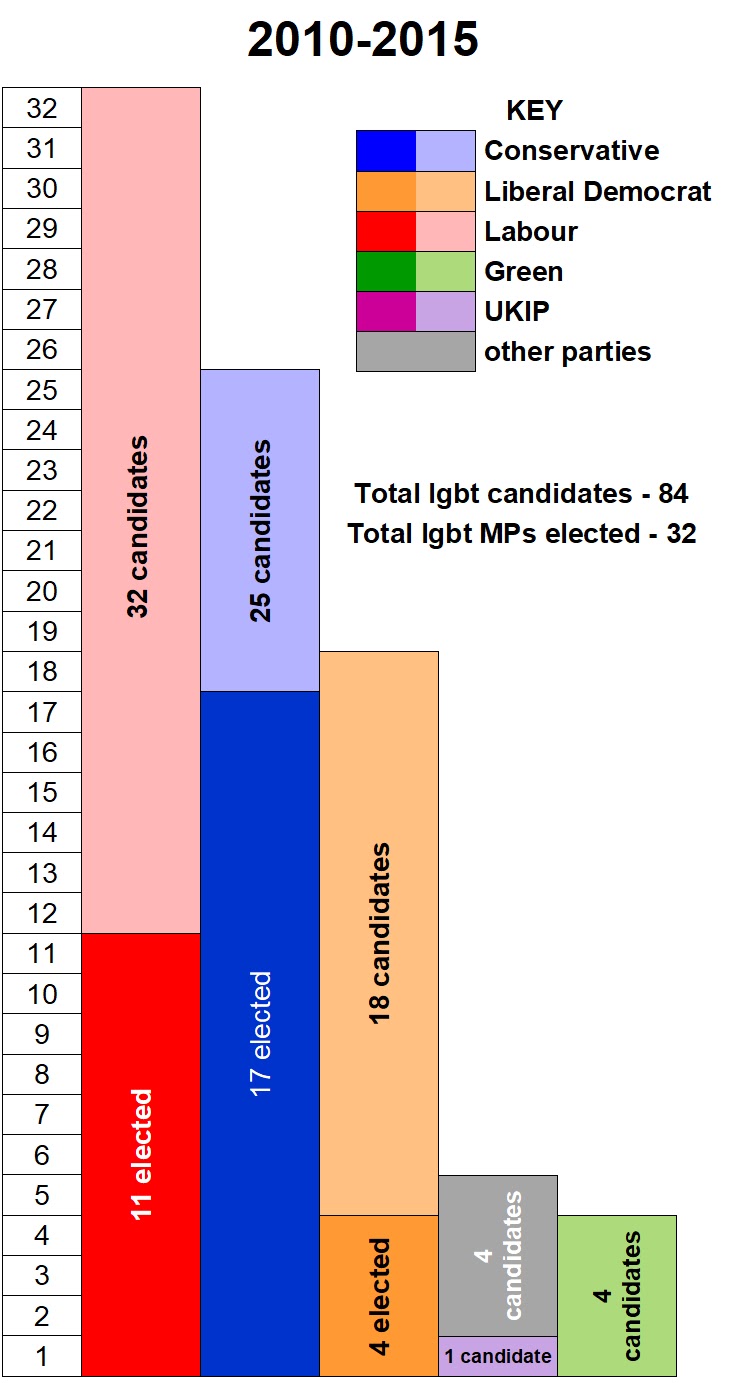
On each side of the tower is a chart showing the total known lgbt parliamentary candidates and elected MPs there have been in the current parliament and the three preceding ones. The numbers include candidates and MPs who were not out publicly at the time.

Below is a video of that exhibit and how it fits together and works. Below that are reproductions of the charts on each side. The date are those of the current and previous parliament and represent periods from the day of one general election to the eve of the next. The numbers includes MPs and candidates who have subsequently come as members of the lgbt community.
I was pleasantly surprised to discover a while back that there were actually some lgbt history tours around the Houses of Parliament themselves. I don’t think any other national parliament does this. The lgbt tour is called Pride at Parliament. It concentrates on stories and politicians connected to the current building constructed. I hope to go on one of these tours myself on one of my annual trips to London.

If you’re heading to London yourself perhaps you’ll have time to go on a Pride at Parliament tour. The tours are on specific dates so you may not be there at the right time. I’ll leave you today with a link to the tours webpage here.

Wednesday, 5 December 2018

Around the World in Another 80 Gays: Part 34) Burning Desires

Previously on “Another 80 Gays” : 70) Count Francesco Algarotti (1712-1764) was involved in a love triangle with 71) Lady Mary Wortley-Montagu (1689-1762) and 72) John Hervey, Lord Hervey (1696-1743), who was satirised as a Roman emperor’s boy husband called 73) Sporus (c.49-69).

When Alexander Pope satirised 72) John, Lord Hervey, in “An Epistle from Mr Pope to Dr. Arbuthnot” in 1735 he chose to identify him as 73) Sporus very deliberately because of Hervey’s openly effeminate, flamboyant, bisexual “macaroni” behaviour which made him an obvious target. In his turn Lord Hervey wrote insulting comments about Alexander Pope, mocking his physical deformities and his non-aristocratic background.

One of the reasons for the antagonism between the two is that Pope was jealous of Lord Hervey’s friendship with 71) Lady Mary Wortley-Montagu. In one of his letters Pope referred to Hervey and Lady Mary as “Lord Fanny” and “Sappho”.

Lord Hervey’s political career brought him into direct contact with the king and the royal family. Several modern government ministers are still hold of offices in the Royal Household. Lord Hervey was appointed Vice Chamberlain to King George II, a government appointment made by the Prime Minister. Hervey’s job was to report directly to the King on proceedings in the House of Commons every day. The current Vice Chamberlain is Andrew Stevenson, and openly gay Conservative MP, and his responsibilities are much the same. In 1740 Lord Hervey was “upgraded” to Lord Privy Seal, one of the highest offices of state in England, again a political government appointment, as it still is.

So, who was 73) Sporus? We don’t know much. What we do know comes from the last two years of his short life. He is said to have been about 20 years old when he died. Even his name isn’t his real one, but a nickname given to him by the man who married him, 74) Emperor Nero (37-68). Sporus is a name derived from the Greek word for “sowing a seed”, the inference of sex being deliberate.

Sporus may have been a freed slave. Whether Nero was his master isn’t known but Sporus certainly came to the emperor’s attention after the death of his wife Poppea.

Imperial politics was very complicated in Roman times. There was no properly defined laws on succession and many emperors died at the hands of their successors. One tactic was to marry into, or be adopted by, the reigning imperial family. That’s how Nero himself became emperor.

Although descended from several previous emperors himself Nero gained the throne through the machinations of his mother Agrippina, niece of Emperor Claudius. To ensure her son’s succession she married her uncle and, in due course, Nero became his successor.

Nero had several wives – and husbands. First was his step-sister, Claudius’s daughter. After executing her over false adultery charges Nero married his mistress Poppea in 62. In 64, the year of the Great Fire of Rome, Nero married Pythagoras (not the famous Greek mathematician), so now he had a wife and husband (Nero is known to have taken the passive role with Pythagoras). The following year Poppea died. It is usually said that Nero kicked her to death when she was pregnant, but historians now think she died in childbirth. Whatever the reason, Nero was devastated by her death. But with Sporus she could be with him forever.

Nero married Sporus in 65 because of his resemblance to Poppea. To give Sporus an unusually high profile in public life Nero had the boy castrated and demanded all citizens treat him as his empress. He was dressed in the empress’s royal regalia at public events. As for Pythagoras, non-one knows what happened to him. But Nero married yet again. In 66 he married Statilia Messalina, who wisely kept a low profile and outlived both Nero and Sporus.

Sporus seems to have actually loved Nero, even though there was a 12-year age gap. He was one of the few people who remained loyal to the emperor right up to Nero’s death in 68.

The Senate and the army eventually rebelled against Nero and he committed suicide. Sporus, however, was spared and treated as an imperial “wife” by two other Romans vying for the throne. However, when Vitellus became emperor in 69 Sporus was planned as the victim in a gladiatorial show. Thankfully, Sporus chose suicide was a less painful death.
Let’s go back to Nero and the Great Fire of Rome. In an earlier article on Nero I mentioned that he was in Antium when the fire took place. This is one of several locations where ancient writers place Nero at the time. One writer puts him in the Gardens of Maecenas. These were part of a villa on the Esquiline Hill in eastern Rome which came into the possession of the emperors after the death of the villa’s builder, a Roman statesman called 75) Gaius Maecenas (68 BC-8 BC).

Over the centuries Maecenas’s name has become a byword for a generous patron of the arts. He came from a wealthy, influential family and a glittering political career could have been his for the asking. Instead, he refused all invitations to become a Senator and spent his life and wealth in promoting the arts. He also built his villa which included the first heated swimming pool in Rome. It also had places where plays and songs were performed in a sort of theatre. It was from a temporary platform or stage that Nero is said to have watched Rome burn, dressed in his theatrical costume and singing of the destruction of Troy.

Maecenas was primarily a patron of the performing arts rather than the visual arts. He loved all types of performance, and he loved a pantomime performer called 76) Bathyllus (c.60 BC-pre 2 BC).

Next time : From Rome to Britain – the pantomime tradition gets an Oscar nomination.