Tuesday, 23 August 2011

The Gayest Games in Ancient Greece - Day 7

Today’s the BIG day for Athens. If fact, there’s so much going on that I’m going to spread it over 2 days. It started at dusk at the end of Day 6 with thousands of people gathering in the streets along the route stretching from the city gate to the Acropolis that is still called the Panathenaean Way.

Being the main religious event in the Athenian calendar, the route needed to be ritually purified before the procession in the morning. This was done with fire. No, they didn’t  set fire to the streets. They turned the ritual into a contest which is the most iconic part of the modern Olympics, which would be fine except for one thing – it didn’t have anything to with the ancient Olympics. I’m talking about the torch relay.

From its beginnings in ancient times to well into the modern revival there was no Olympic torch relay until Hitler stole the idea from the Greater Panathenaean Games and hijacked the Olympics for political means.

Once again, each of the 10 demes (tribes or boroughs) of the Athenian city-state chose 4 athletes as their team. The winning team is the one who gets their flaming torch to the Acropolis without it going out or dropping it. Because the winning torch would be used to light the main sacrificial fire the pride of the demes was at stale.

Luckily, the importance of this race means that it is represented on lots of pottery, so we have a good idea of what it might have looked like.

The race begins at the entrance to the sacred olive grove of Academia outside the city wall. It was here that Charums, the lover of father and son Peisistratus and Hippias, built an altar dedicated to Eros (see Tuesday’s entry for their complex relationships). Eros was a patron god of love among male athletes, and as mentioned on Day 2 was important in training.

As soon as the sun had set, the first runners of each team lit their torches from the altar of Eros. The other runners were at their places along the route at half-mile intervals. As with all athletic events the runners were naked. The only way spectators would tell which team they represented was by a sort of crown or head-dress each runner wore. Presumably all 10 teams ran at the same time rather than heats, and pottery shows that the whole torch was passed on rather than the flame lighting the next one.

Through the streets crowds would cheer the runners as they saw the torches approaching, and the priestesses of Athena could follow the progress of the race from high on top of the Acropolis.

The climax of the race was at the top of the steps leading into the Acropolis. I imagine this would have been a popular spectator spot like all finishing lines. To cheers and jubilation all round the winning torch was taken into the sacred precincts ready to light the sacrificial altar later that day.

But if you think the Athenians could relax before dawn you’d be wrong. The big procession was to take place as the sun rose on Day 7, with hundreds gathering back at the city gate to prepare all the various offerings. It was another spectacular event, too big to mention today, so I’ll tell you about it tomorrow. It will be a memorable sight – the world’s biggest dress, a ship on wheels, an assassination, and the biggest barbecue for 4 years.

If you’d like to know more about the Greater Panathenaean Games – the Gayest Games in Ancient Greece – go to www.athens-greece.us/panathenaea.

Monday, 22 August 2011

The Gayest Games in Ancient Greece - Day 6

I must admit I was looking forward to Day 6 of the Great Panathenaean Games. Compared to the previous days not much happened today, but its what happened that makes it more gayer, even camp, in comparison.

Unlike the games so far, Day 6 begins the Athenian-only games that last for the rest of the festival, and it switches from individual to team events. Competitors were now representing their local area, and the competition between the 10 demes of Athens (areas like town boroughs) was intense. Day 6’s events were at the core of their Greater Panathenaean festival, and everything was done as an act of devotion to Athena. Because of this there was an extra incentive to win, especially the first contest where the winners of the 3 age groups (12-15, 16-20, and over 20s) were to lead the big religious procession the next day.

It was a beauty contest. Not so much Miss World as Mr. Athens. Each deme chose up to 24 men in each age group who were the tallest, most graceful, well-proportioned and most drop-dead gorgeous. As well as overall beauty and physique the contestants were judged on their performance of graceful movements and agility based on combat techniques. Sounds a bit like t’ai chi. The winner of the 12-16 age group appears to have been decided on looks alone, as at that age the boys wouldn’t have done as much training as the older men and not have acquired the necessary muscle structure. One change from previous events was that contestants weren’t naked – which I would have thought defeated the object. Anyway, records say that they were dressed in the best festive garments – all dragged up, you could say.

The next contest also involved combat techniques. Teams of up to 24 men, again, from each deme, this time with helmet and shield, performed synchronised moves to music, but it was far from a military march. Just like a row of Tiller Girls the soldiers would hop and skip in unison, wave spears and shields, and posture as if about to attack the enemy. I wouldn’t say that its as camp as the rows of the high-kicking Canadian Mounties at the closing ceremony of last year’s Vancouver Winter Olympics, but it’s pretty close I imagine.

Interestingly enough, as well as male beauty contests still being held today, they still have “dancing soldier” displays today in the Balkans, especially Albania.

The first prize for both contests was a bull to be sacrificed the next day. Money was also awarded, to be shared around the deme.

During the rest of Day 6 people would be gathering at the city gate and along a specific route through the city. Athens is going to provide its citizens and visitors perhaps the most magical spectacle to be seen in the ancient Greek world, and it wouldn’t give them much time to sleep.

Even if the Athenians didn’t get much sleep, I will. I’ll tell you about the special night-time contest tomorrow.


If you’d like to know more about the Greater Panathenaean Games – the Gayest Games in Ancient Greece – go to www.athens-greece.us/panathenaea.

Sunday, 21 August 2011

The Gayest Games in Ancient Greece - Day 5

Clare Balding would have loved Day 5 of the Greater Panathenaean Games, but being a woman she wouldn’t have been allowed to watch. Day 5 was all about equestrian events, complete with chariot races.

Chariot racing is first recorded by Homer in the “Iliad”, the story of the Trojan War. In that poem, recited as part of the poetry contest on Day 1, hero Achilles decided to hold games at the funeral of his boyfriend Patroclus.

Funeral games were common in Ancient Greece. Herodes Atticus, a great benefactor and descendent of the founder of Athens, rebuilt several stadiums where the Greater Panathenaean Games were held in the 2nd century AD. His boyfriend, the athlete Polydeukes, died young, and Herodes held massive funeral games in his honour in the stadiums he rebuilt. He also had the marble carving made of Polydeukes which shows him to be extremely young (right), which may be partly artistic license though it’s probable he was less than 20 when he died. Herodes was so upset that he died of a broken heart not long afterwards and his own funeral was held in the very same stadium.

The equestrian events were divided into the usual age groups, even the 12 year olds competed. And it wasn’t only the humans who were divided into age groups – there were races for young and mature horses. During the day there was also a procession of chariots and horses in honour of the city’s patron goddess Athena.

There were several different types of race, and for them athletes were allowed to wear protection rather than compete named as normal. But that probably only meant a helmet and shield. The chariot races were much like the more familiar Roman ones, with 2-horse and 4-horse chariot races. One contest gradually disappeared from the games. It was horse-ridden race with soldiers throwing javelins, presumably at speed.


The most prestigious equestrian event had the name of apobates. A picture of one contestant in the race appears on a vase in the Getty Villa (photo by Brian McMorrow). The chariot, which could have 2 or 4 horses, as here, had 2 occupants – a driver in a flowing robe, and a soldier. As the chariot charged around the course the soldier had to jump off the moving chariot at a given point. After running alongside for a distance the soldier had to jump back onto the moving chariot at another given point.

The winner of this race was given the biggest prize of sacred olive oil in the whole games – 140 vases. Given that one vase contained 10 gallons (45.46 litres) of sacred oil worth the equivalent of £1,000 a vase, you can see how important this race was.

And so Day 5 draws to a close, and we head towards another change tomorrow. Until now all the contests have been open to anyone (male-only, of course), and have been held as entertainment. But as soon as the sun has set the religious element comes to the fore and the games are restricted to citizens of Athens alone. Others can watch but not compete. And if you want to hear about the gayest of these gayest games, then come back tomorrow. Ooh, I can’t wait! You’re in for a treat!

If you’d like to know more about the Greater Panathenaean Games – the Gayest Games in Ancient Greece – go to www.athens-greece.us/panathenaea.

Saturday, 20 August 2011

The Gayest Games in Ancient Greece - Day 4

Yesterday at the Gayest Games in Ancient Greece we looked at all those naked, bronzed, oiled-up male athletes running their races and throwing their javelins. Today we’ll see them get close and personal in the boxing, wrestling and pankration.

The rules for these fighting sports were a lot different to today’s. All 3 age groups were expected to compete – 12-15 years, 16-20 years and the over 20s. There were no weight categories in any group, so the smallest fighter had to fight the biggest if their names were pulled “out of the hat” together.


Boxing was said to have been invented by Apollo, the god of sport. He had several young boyfriends with sporting connections. The most famous was Prince Hyakinthos of Sparta who was killed by a flying discus. The Spartans founded the Hyankinthia festival in his honour and held many sporting contests, as well as naming a flower after him.

Wrestling was more like the current Olympic sport rather than the American version. Again, there were no weight categories. Tripping was allowed by biting and gouging weren’t. One Athenian athlete who became an Olympic wrestling champion was Pantarkes. Born in about 450 BC he became a trainee sculptor at the age of 12 to Phidias of Athens. It wasn’t long before they became a couple. Phidias was a bout 40 at the time. There was no thought of paedophilia as a crime in those ancient days. The boys expected it and it was always consensual.

Phidias is the man who redesigned the Parthenon so it could be used as the grand highlight of the Greater Panathenaean Games on Day 7 and he built HUUUUUUGE statues. One of them became one of the 7 Wonders of the World – the statue of Zeus at Olympia (right). This was almost 40 feet tall (12 metres) and made of ivory and gold plated bronze. Phidias was clearly  smitten with young Pantarkes when he was building it. Pantarkes, who must have started his wrestling training when they met, had a well-toned body and Phidias used him as a model for one of the figures decorating Zeus’s statue. Phidias even carved “Pantarkes is wonderful” onto one of Zeus’s little fingers. Pantarkes would have watched the Greater Panathenaean Games, maybe even competed in a couple of them.

The third contact sport was pankration. This was very brutal and a no-holds-barred version of ultimate cage fighting (without the cage). As such it was the best training for soldiers in the gym and one of the most popular. Plato once wrote that one pankration contests attracted thousands of competitors! Again, the origins of the sport go back to mythology. Hercules (left) is one named originator. Both the Disney cartoon and the TV series of a few years back always forgot to mention that Hercules was the hero who had more boyfriends than any other – at least 4.

Pankration fighters were often the butchest athletes around, mainly because it involved developing more muscles, strength and agility than any other. One famous fighter attracted the attention of bisexual Alexander the Great. He was Dioxippus, a soldier in Alexander’s army who had been the Olympic pankration champion in 336 BC. As an Athenian native he would have seen and even participated in the Gayest Games.

Even though non-Athenians took part in other events, one group was excluded from the pankration because they were too good – the Spartans. Their reputation as the ultimate fighting warriors would not have produced much of a competition.

With Day 4 coming to a close we look forward to a change of sport tomorrow and a whole day of equestrian events.

If you’d like to know more about the Greater Panathenaean Games – the Gayest Games in Ancient Greece – go to www.athens-greece.us/panathenaea.

Friday, 19 August 2011

The Gayest Games in Ancient Greece - Day 3

Let the games begin! At last the athletics contests start and we get a chance to see what effect all that hard training has had on all those naked male sportsmen.

Like in the modern Olympics there were several different events, enough for 2 days competition, so I’ll divide them up into 2 parts. Today I’ll look at the track and field events.

These were introduced by Peisitratus (already mentioned several times this week) in 566 BC and were purely for entertainment and not part of the religious festival it accompanied.

Most of the track races were much like the Olympics races but different in a couple of ways. Originally they were held in the agora, the central meeting and market place. A special wooden stadium was later built, which in 330 BC it was rebuilt in marble. This is the stadium that hosted the first modern Olympics in 1896. The second difference was that the races were arranged into 3 age groups – 12-15 years, 16-20 years, and the over 20s. In this respect it’s more like the modern Gay Games, where medals are awarded according to age groups.

The races were held in heats and finals, with the youngest age groups having all their races first. This would have given their older mentor/boyfriends chance to watch and cheer them on, and later the younger athletes could do the same for their older partners. The over-20s had an extra race – a race in armour. Not full armour, but with helmet, shield and shin guards. Apart from that they were competed naked.

Non-Athenians were allowed to compete, but perhaps in their own separate races, and no-one at this stage represented anyone other than themselves, there was no national grouping. As in the ancient Olympics, their victories could not be claimed by their home city or country.

Instead of medals, vases of olive oil (like the one pictured left) were awarded to the top 2 winners of the finals, 10 for the second place, and between 40 and 50 (depending on the event) for the first. I hope the London Olympics don’t decide to save money and follow this example by handing out bottles of Tesco’s Value olive oil! But the Athenian oil was special. It was made from olives grown in the scared groves of Academia outside the city walls. The Athenians believed that if they kept the sacred oil and rubbed it on their bodies at future games they could increase their strength, speed and agility, a bit like Popeye’s spinach, though I don’t recommend rubbing spinach on your body! The oil could be sold for a very high price, being sacred oil, and the few surviving vases are highly valuable today.

Vases of oil were also awarded to the winners of the pentathlon. This was also much like the modern event. It consisted of a track race, javelin, discus, long jump and Greek-style wrestling. No-one is sure if the pentathlon contest was won on points like it is today.

So they were the track and field events. Also held on Days 3 and 4 were the wrestling and boxing matches. I’ll tell you all about those tomorrow.

If you’d like to know more about the Greater Panathenaean Games – the Gayest Games in Ancient Greece – go to www.athens-greece.us/panathenaea

Thursday, 18 August 2011

The Gayest Games in Ancient Greece - Day 2

Day 2 of the Greater Panathenaean Games was a continuation of the song and  poetry contests from Day 1 – each song and poem lasting several hours each, with at least 6 contests to go though.

I mentioned several days ago that each gym had an altar to the god Eros, known to the Romans as Cupid. I was a bit sceptical about this when I first read it, but it’s true.

Forget the sickeningly sweet Cupid of St. Valentine’s Day. The original Eros was as macho as any other male god even though he was shown younger than, say, Apollo or Ares. Statues (like the one on the left) and pictures of him on pottery show him much like that of Anteros in Piccadilly Circus.

Eros’s name translates literally as “intimate love”. This love meant more than just sex. It was customary for Ancient Greek youths over the age of 13 to have an older mentor, whether in the gym or other learning establishment, who would help with the education. The relationship was always sexual and meant more to the couple than any they would have with a woman, even in marriage. Understandably, Eros because associated with male couples.

A lot of what we know about their erotic desires comes from pottery made during the reign of Peisistratus, whose dynasty I mentioned 2 days ago. Many pots show sexual encounters, and a study of them shows 30 pots of men and women together, and 528 of men with men. Eros himself appears on many of the pots to highlight the erotic nature of the relationships, but only pots depicting 2 men. So erotic feelings between men and women were not considered normal. I wonder what straight blokes today would say if you told them that they could only have erotic thoughts about other men!

At the entrance to every gym there was an altar and statue of Eros. On entering and leaving the gym each athlete would stop to give prayers, offerings or thanks to Eros. In the gyms relationships became more significant because of the shared desire to develop the body and strength of a Greek god and to make them ready for battle. There was nothing unusual in seeing 2 bronzed, ripped athletes being openly affectionate as they trained with the other athletes (sex was a more private affair).

As they advanced through their teenage years athletes would choose a new young trainee to mentor in the same way. By the time they were 30, though, they were expected to be married. This situation is best illustrated in the relationships I mentioned 2 days ago. Athenian ruler Peisistratus was mentor/partner to Charmus, who later on was mentor/partner to Hippias.

On Charmus’s death either Peisistratus or Hippias built an altar to Eros outside the city walls and dedicated it to both the god and Charmus, and naked athletics. This altar was an important location in the “Gayest Games” in that it was the starting point for one of the most popular contests in the games, the torch relay on Day 7.

But let’s not get ahead of ourselves. It’s Day 3 tomorrow and the athletics contests begin.

If you want to know more about the games go to www.athens-greece.us/panathenaea

Wednesday, 17 August 2011

The Gayest Games in Ancient Greece - Day 1

Today (give or take a day) was supposed to be the beginning of the Ancient Athenian year. It was chosen because it was the birthday of the city’s patron goddess Athena. All inhabitants of the state were allowed to take part (except women and slaves) in the 4-yearly Greater Panathenaean Games – the Gayest Games in Ancient Greece.

Day One was the day for music. The city’s ruler Peisistratus (whose family are inextricably linked to the games) introduced a series of song and poetry contests to the games just after 566 BC.

Three contests took place which involved
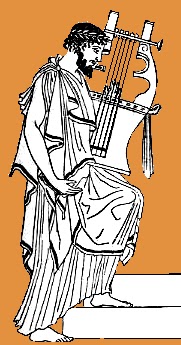
1)      singers accompanying themselves on a kithara (a kind of lyre, below left),
2)      singers accompanied by someone else playing a reed instrument (below right),
3)      and purely instrumental reed instrument players.

Thankfully there were no percussion instruments, so the Athenians were spared the “boom-bang-a-bang” of modern Eurovision songs camping things up. Even better, no annoying, fatuous Terry Wogan. The winners of each contest were awarded a gold olive crown and 300 gold coins – but not yet, contest winners had to wait till the end of the games before they got their prizes.

The poetry contest involved all contestants reciting a long poem, each taking a set of verses in a kind of poetry relay. Hipparchus standardised the texts for the contest, introducing the famous poems by Homer. One regular section to be recited at every games was the death and funeral of Patroclus, the best friend and lover of Achilles. Now, I don’t remember seeing Brad Pitt (as Achilles) and Garrett Heldund (as Patroclus) spending much time in bed together in the film “Troy”, unless I blinked, but they should have done if the producers expect us to take the characters seriously.

These musical contests were originally held in the agora, a market and meeting place in the centre of Athens. An odium with a bit of cover was built in the 440s BC by the city’s ruler Pericles.

Given that the poems were hundreds of verses long, and given that each song and poem contest was held twice (once for adults, once for boys under 16), the contests could have lasted several days. So if you think the Eurovision Song Contest was too long, be thankful you didn’t have to sit through Day 1 of the Panathenaean games!

With the song and poem contests dragging on into Day 2, tomorrow I’ll explain a little more about why Eros and not a more macho god was the patron god of the gymnasiums and just why is was OK for Ancient Greek men to have a boyfriend.

If you want to know more about the games go to www.athens-greece.us/panathenaea