Showing posts with label drag. Show all posts

Saturday, 15 February 2025

Queer Carnival Cats

Carnival season is with us, and in Venice they celebrate in spectacular form next week.

Last year, in “24 for’24”, I mentioned that one specific mask worn by Venetian carnival goers traditionally indicated that the wearer was a gay man. That mask and the person wearing it is called a gnaga.

To tell the full story we have to go back to the early years of the Venice carnival. Carnivals have been held across Christian Europe for centuries to celebrate the start of Lent, a tradition borrowed from the Jewish festival Purim.

In some places carnival season begins just after Christmas. In fact, there is evidence that the Venice carnival once ran from December 26th until Easter. In medieval times, Traditional carnivals only occurred during Lent. Other similar masquerade festivals were not confined to a particular season, month, occasion or religion. If you had the means to travel and knowledge of where to go (not to mention the stamina), you could go around Europe and visit a carnival or other masquerade festival on most weeks throughout the year.

A major component of carnival as it developed over the centuries was the introduction of masquerades. In essence, masquerades were very much like the medieval Feast of Fools held in winter, or the solstice celebrations in summer, in that social roles were reversed (also something not confined to a particular season, month, occasion or religion). The idea behind wearing masks, in whichever carnival you attended, was to remain anonymous, allowing wearers to get away with things they couldn’t in everyday life.

There were various laws across Europe which governed which class of society was entitled to wear which type of clothing and which type of material. During masquerades these laws were relaxed. In Venice, people were allowed to wear anything at the carnival, as long as they also wore a mask. No mask, and you could be breaking the law if you were wearing the wrong type of clothes.

Even though the Venice carnival had been going for over a century, it wasn’t until 1268 that the wearing of masks was recorded. It is also recorded that masked men would go around throwing eggs filled with rosewater at women, someone the man had a crush on. Being masked, however, meant that the men could not be arrested or punished.

While wearing a mask you were playing a character. You weren’t playing yourself. You couldn’t be arrested for playing a character, which is how gay men exploited a loophole in the law.

Venice took a stand on opposite sides regarding homosexuality and prostitution. Like the UK before 1967, homosexuality in Venice itself wasn’t illegal, just immoral. What was illegal was gay sex, or soliciting for gay sex. Men found guilty of having gay sex were hanged in St. Mark’s Square and their corpses burned.

In the 15th century the council of Venice decreed that two noblemen should be elected to monitor gay sex activity. Physicians were required to report any injury or condition in their male patients that implied gay sex was involved.

So, you can understand why gay men took advantage of the loophole in Venetian law which allowed them to solicit for sex in public without being arrested and executed. All they had to do was put on the gnaga cat mask and women’s clothing and go to the Venice carnival as a gnaga.

No-one really knows why gay men began wearing gnaga masks, but it is recorded that they would make meowing noises and speak in a high voice. So, whether the mask came first or the imitation of a cat is open to debate. If the gnaga were feeling particularly dedicated in their portrayal they might also carry a basket full of fluffy little kittens to attract attention.

There’s one known instance of one gnaga who went a bit too far. It is recorded that on 4 May 1710 a gnaga began teasing a group of Turkish visitors to the carnival. They weren’t happy with his “catty” remarks and began to raise their guns. Startled by this, the gnaga turned and ran out of the city. The record doesn’t say if the man stopped to remove his mask and costume, or that he ever came back.

All went well for the first centuries of the carnival, but the loophole enjoyed by gay men and male prostitutes soon began to worry female sex-workers.

While homosexuality was punishable by death, prostitution was seen as a necessary vice, an immorality that was tolerated. In 1360, some houses near the Rialto market were designated as a kind of state-sanctioned red light district. Sex-workers had to live in houses under the management of guardians, who distributed the earnings equally at the end of the month. The women weren’t allowed to leave their house during the most important holy days, or after dusk.

By the 1400s the sex-workers were worried about the many gay men and male prostitutes that had been attracted to Venice and were becoming a bit too successful in attracting male clients, especially during the carnival. The women appealed to the authorities to do something to protect their livelihoods. The solution was quite novel and imaginative.

Bearing in mind that gay men and male sex-workers often dressed as women, female sex-workers were allowed to stand at their windows or on their balconies with their breasts exposed. This would reveal if the sex-worker was female or not. Some were even paid to line up on a bridge with their boobs out for all to see. This bridge soon earned itself new a name – the Ponte della Tette, meaning the Bridge of Tits. The surrounding area also acquired similar names – the Fondamenta de la Tette, and the Calle de la Tette. The bridge still exists, though you’re not likely to see (knowingly) any sex-workers.

Back to the carnival. After Venice came under the control of the Holy Roman Empire (based in Germany and Austria) in the 18th century, the carnival and its masks gradually fell out of popularity and virtually disappeared. It wasn’t until 1979 that the full carnival was revived. The traditional masks were recreated, and the gnaga cat mask has proved to be very popular. However, the link to gay men and male prostitution is largely disregarded and wearing it is not necessarily worn to go cruising for sex. Nor is wearing of the gnaga mask confined to gay men anymore.

With the revival came a new competition to choose the best costume and mask of the carnival. This competition has been held every year (except 2020, the covid year). Among the people who have won this competition several times is the openly gay German designer Horst Raack (7 times between 2009 and 2021, that last occasion was an online carnival due to covid).

I’ll end with two images. On the left is an 18th century illustration of a gnaga by Venetian artist Giovanni Grevembroch (1731-1807). On the right is one of Horst Raack’s winning designs from his entry “The Children of Light” in the 2019 Venice carnival. You can see more of his fantastic costumes on his Facebook and Instagram pages.



Sunday, 15 December 2024

Advent 3: Christmas is a Bit of a Drag

Modern drag has advanced little since the start of this century (if at all). Much of it is lingering in the style of the 1980s, desperately trying to appear relevant and significant in today’s world, and failing, due to drag’s outdated gay stereotypes. However, it is far advanced from the drag and female impersonations of a hundred years ago.

If we go back further to look at what influenced modern drag we find the British pantomime dame and, even earlier, the character of the Italian commedia dell’arte. And even further back than that, we have comic female characters played by men in medieval mystery plays based on stories in the Bible.

It has to be admitted that these very early drag-like performances were purely for entertainment purposes and no gender identity was assigned to the performer. It is well-known that at one time women were not allowed, or discouraged, to be actors. That meant that any female character, including the Virgin Mary in Christmas nativity plays, were played by men or boys.

One development of the medieval mystery play is one I wrote about in 2019, the French Société Mattachine. In that article I explained how the early gay rights organisation in the USA, the Mattachine Society, was named after these medieval performers.

The Mattachines were not confined to France. The name seems to derive from the Italian “mattaccino”, which comes from “matto” meaning “mad”. From this we understand how the comic characters found in various mattachine groups throughout medieval Europe act in over-the-top performances, as if mad.

If we skip across to Spain we find the matachines who were popular in the 17th century, quite some time after other European variations had begun to die away. Because of this, the Spanish matachines is the form which has survived today – but not in Spain.

The Spanish matachines had developed into a more musical and dance form rather than drama. It still had the stock characters familiar in all its forms in Europe – a hero, a young woman, an old man, a villain, and more pertinent for our purposes today, an old woman played in drag. A particularly Spanish addition to the cast was a bull.

But what have the matachines got to do with Christmas? Bear with me while I digress. We have to look at how the matachines dances evolved after the Spanish colonised Central America. There’s a debate which is pertinent to the matachines, and Christmas in general. It concerns what I believe is a common misconception constantly repeated at this time of year that Christmas traditions are actually pagan. No matter how much research in many academic papers and books I can find no actual proof of this, only a lot of unsupported opinion based on coincidence from the 18th century onwards (not to mention modern crap about Santa and Coca Cola). Thankfully, an increasing number of qualified historians have debunked many of these pagan lies. Just because two things sound or behave the same it doesn’t prove they’re connected.

Usually, the Christian Church is presented as adopting pagan practices to encourage indigenous communities to convert to Christianity. I believe the opposite. I’m not alone in this. This 2021 article on the history of matachines in Mexico from the Universad Nacional Autómona de México comes to the same conclusion. It is becoming clear through modern research that it was newly converted indigenous communities who looked at what Christian practices were similar to their own and then adapted them without losing their own cultural identity. The Christian Church authorities, in their turn, saw no reason to object and, as long as Christian doctrine was followed, accepted the new ethnic take on their practices (except a handful of puritan extremists, like those today who want to ban “Harry Potter” because it “promotes witchcraft”).

The Spanish Conquistadors spread their matachine dances across Central America. In Mexico the Aztecs in particular merged it with their own dance rituals and produced a variation which they still use today, a variation that actually includes a king character based on Moctezuma (Montezuma). This is performed on special occasions, though not often at Christmas as with their US Pueblo counterparts. It also has a slightly different name – matlachine.

The two female characters of the Pueblo matachine are called Malinche and Perejundia (or Abuela). The Perejundia is always played by a man in drag, and the Malinche is now usually played by a girl. They represent opposites. Malinche is a beautiful, young, innocent girl, while Perejundia is an ugly, bawdy and coarse old woman. The video above shows one of the few clear visual representations on YouTube of the bawdy Perejundia.

Usually, matachine dances are performed during Advent, most often on December 12th, the Feast of the Immaculate Conception celebrating the conception of the Virgin Mary (often referred to as Our Lady of Guadelupe). This is also the date which is generally considered as the start of Christmas in the Pueblo communities. In fact, several matachine performances have taken place this week. Because the celebration is religious and often performed inside churches, the Perejundia character is sometimes omitted. The video below is the matachine from two days ago in Laredo, Texas. You can see the Malinche played by a very young girl, and the old man character, but no Perejundia.

Prof. Brenda Romero of the University of Colorado, an expert on hispano-indigenous music, has noted that matachines among Pueblo communities have become quite inclusive. She says that gay men (and women, as can be seen in the video below) are actively involved. I may be assuming too much, and this is only my theory, but are some Pueblo gay men specifically drawn to playing the Perjundia in the same way that some gay men in the USA become drag performers? I have absolutely no evidence or proof of this, but it’s an interesting thought.

Whatever the gender identity of the person playing the Perejundia in the Christmas matachines, it is clear that there is a direct line of descent from medieval mystery plays to the commedia dell’arte, the Perejundia, the British pantomime dame and modern drag queens.

Next week we look at a Hellenic Christmas gift-giver and his association with a reluctant priest.

Thursday, 31 October 2024

A Queer Bogeyman

Hallowe’en is with us again, with its US-inspired misappropriation and distortion of traditional European customs and neo-pagan fakery.

The world is full of monsters and evil spirits who “live” all year round in every culture. There are no supernatural spirits that are specifically associated with Hallowe’en (unlike Christmas). Some of these spirits lurk in the shadows, ready to pounce on the unsuspecting. They are a wide range of bogeymen, a general name given to the many different types of spirits and monsters in all sizes and physical forms often used by parents to keep their children in order.

In South Africa there’s a bogeyman that has some gender-bending characteristics called Antjie Somers.

While most bogeymen originate in centuries-old folk belief, Antjie Somers can be traced back to more recent times. The first printed reference appears in a South African magazine called “The Friend of the Free State”, published in Bloemfontein on 10th August 1866. I haven’t been able to track down a copy of this edition but I have found snippets and references to it from other sources. From these it seems that Antjie Somers was a devilish character who stalked the streets at night, preying on lone travellers or looking for naughty children to carry away in his sack.

Several different urban legends and folk motifs merge in this Afrikaan bogeyman. First there is the Sackman, common throughout the world in many forms, including the original 19th century American Santa Claus who has a sack from which he distributes presents to good children and kidnaps naughty children (later downgraded to a “naughty list”).

Another common folk motif in Antjie Somers is the urban myth of a highwayman or robber disguising himself as a vulnerable character in need of protection or rescue. The urban myth of a hitch-hiker who appears innocent and turns into a bogeyman is still quite common. Although hitch-hiking bogeymen are scary they are also not very intelligent. Victims who see through the disguise can easily make an excuse to stop the car or horse and carriage by saying they accidentally dropped something onto the road, or there’s an obstruction ahead and ask the hitch-hiker to get out and pick up or remove the object. The potential victim can then just to drive off at speed, leaving the bogeyman behind.

A third common folk motif is one which concerns us today, that Antjie Somers is a male bogeyman disguised as a woman. This is a variation on the preceding hitch-hiker motif (commonly referred to as “the hairy-armed hitch-hiker”). There’s several indexes of world folk motifs. In the Thompson Folk Motif Index, for example, tales of a man disguising himself as a woman is category K.1836.

The 1866 “The Field” article states that there were two bogeymen called Antjie Somers and Antjie Winter, one operating in summer and the other in winter, hence their names. The article indicates that the characters were known from the time of Lord Charles Somerset who was the Governor of Cape Colony 1815-26.

Over the decades, these urban myths merged to produce the Antjie Somers known today. Such additional myths include his ability to become invisible and to fly around in the sky, other common motifs applied to evil spirits in European folk tales. The Dutch, the ancestors of the Afrikaans, certainly had legends about female-disguised robbers, as did other European colonists.

By the mid-20th century the stories of Antjie Somers had been reduced to those told to scare children. This was part of a general global turn from traditional folk stories and customs as humanity began to turn away from old days of superstition and into the modern scientific and technological world.

When Pieter W. Grobbelaar, a South African author and folk tale collector, published his 1968 book “The Most Beautiful Afrikaans Fairy Tales”, he wrote the “full story” of Antjie Somers. Briefly, it went like this: Andries Somers was a brave and strong Afrikaans fishermen. No-one could haul in the full nets as fast as he could. One day, the other fishermen became jealous and attacked him. Andries knocked them all to the ground, but one fisherman didn’t get up. He was dead. Andries, hoping to avoid being accused on murder, stole some women’s clothes to disguise himself and ran away. He managed to find work in another part of South Africa. His new work colleagues found the stolen clothes in his hut and began taunting him, calling him by the female name Antjie Somers. Andries could bear it no longer and fled once more and was never seen again. However, children began talking about an old woman in the mountains who was always angry and kept threatening them. People believed this was Antjie Somers and that children should keep away or he would carry them away in a sack. From this Antjie developed into a bogeyman. This was Grobbelaar’s version.

By the end of the century the origin myths of Antjie Somers had been further elaborated. Rather fancifully, modern social rights were applied to the bogeyman’s origin, including sexism and racism.

The first modern interpretation came from feminist activists who claimed Antjie Somers is proof of the patriarchal misogyny of the 19th century. As mentioned above, Antjie Somers is just one of many variations of combined folk motifs. The Thompson Folk Motif Index lists other disguises used my male bogeymen in folk tales, including animals, old men, and other people. There are also folk motifs of female bogeymen disguising themselves as men, even among the Afrikaans. Even today, most female fiction writers feature men as the main villain. Very few write about evil women.

Next we come to the most obvious fake addition to Antjie Somers, the idea that he was a slave and his myths are racist. I haven’t found any reference to Antjie Somers being either a slave or black before 2000. The version by given by Grobbelaar in 1968 clearly identifies him as Afrikaans, i.e. white, and every other reference I’ve found from that period implies the same.

The black slave link seems to originate in a musical called “Antjie Somers” which premiered in South Africa in 2000. The musical sets the origin of the Antjie Somers legend in 1834 which contradicts the 1866 “The Friend” article which dates if before 1826.

The character of Antjie Somers is portrayed as a black ex-slave. The musical’s creators haven’t said why they changed his race, or why the musical is set in the wrong period. The disturbing aspect, however, is that people who saw it probably went away thinking it was historical fact, like people have who have seen the musical “Hamilton” or the film “Braveheart”.

This is probably why a South African student wrote an MA thesis in 2011 about Antjie Somers which was solely based on the “fact” that the bogeyman was based on a real slave. The student even retold Grobbelaar’s 1968 version of the legend and wrote quite specifically that she changed Antjie’s race to a black purely to suit the purpose of her thesis, not because she had any new proof. Why her university didn’t throw out this student’s pathetic attempt at academic research is puzzling.

Be that as it may, the idea that Antjie was a black slave soon spread across the internet, and every time it appears it is usually repeated word-for-word as if it was fact, so that now it is virtually impossible to find any reference that restores the original version.

One earlier attempt to discover the origin of this bogeyman to find any basis in historical fact was made in the mid-20th century. One South African historian was told a story by a respected poet and folklorist C. Louis Liepoldt (1880-1947) who, in turn, heard the story from an elderly couple in around 1900. In their youth they were told of a real un-named robber who stalked Tuin Street, Cape Town, dressed as a woman. It was a rough area and most people avoided going there at night. When his activities became too well known he feared capture and ran away into the mountains.

This may just have been a story about a different robber, and there are other origins that have been suggested, including being the ghost of someone who committed suicide. Whatever Antjie Somers’ origin story actually is, he’ll be scaring children and travellers for generation to come.

I hope I haven’t put you off going out tonight, so why not stay indoors with a nice bottle of wine. A few years ago you could have enjoyed a nice sauvignon blanc from Folklore Wines in South Africa called Antjie Somers (pictured below). I don’t think it is available now, but you’re free to search around for a bottle.

For me, I’m celebrating Hallowe’en as it was intended, by remembering our ancestors, like the ancient Roman festival in late October which inspired the Roman Catholic Church to create Hallowe’en in the first place. The neo-pagan cultural appropriation of an alleged British Celtic festival unknown to the distant Italian Catholics, is not for me.


Sunday, 19 December 2021

Advent 4: Christmas Travesti

Over the past three Sundays I’ve presented some results of research into Christmas gift-bringers and characters. I’ve shown how some of them have changed gender over the centuries, and that some of them have often been played in traditional customs and pageants by someone of the opposite gender.

The terms “cross-dressing” and “drag” have become too associated with expressions of gender and sexual identity. Today I’ll be using an additional term. In the performing arts the term “travesti” is used to describe the portrayal of a character by a person of the opposite biological gender, regardless of whether that person is lgbt or not (to confuse matters even further, I’ll not be using the term “travesti” as used in South America for transgender people).

As with a lot of things, travesti roles began in ancient times. Here we have to make another distinction. Historians and academics often give the impression that ancient communities never did anything that didn’t involve religion and worship. The buzz word “pagan” appears like a virus, spreading through research and literature to explain everything we don’t have evidence for. What very few historians mention is that some traditional customs could have originated because people just wanted to have fun and let their hair down. Children role-played for fun just as they do today. Fun and faith went alongside each other, just like our modern Christmas. The Roman festival of Saturnalia, often erroneously quoted as being the origin of Christmas, is an example. So little is known about Saturnalia that no-one knows what they did except have wild parties. Evidence does suggest, however, that role reversal took place, but none to suggest it involved cross-dressing.

Some activities in religious festivals seeped into secular life, and vice versa. Today it is often impossible to say which effected the other the most. As far as cross-dressing in concerned, many pre-Christian religions had male priests who wore female masks in some ceremonies. Female masks have been found in Greek temples dating to 5,000 years ago. They were also used in Greek theatre in both comedies and tragedies.

The early Christian Church frowned upon cross-dressing, teaching that it was immoral and antisocial. It even became illegal to cross-dress in public in many nations. However, if the person (a man) was doing so as part of a theatrical performance, it was okay. This explains why the Church accepted travesti roles in religious ceremony. During the Middle Ages processions and portrayals of Biblical stories were popular. They were a way for the Church to inform the ordinary people who couldn’t read about Bible stories. This gave rise to the Passion plays of Easter and the Mystery plays of Christmas. In both of these plays female roles were played by men, even the role of the Virgin Mary.

During the Middle Ages communities began to organise their own little celebrations. The Mystery plays evolved into community “mumming” plays in which comedy, parody and travesty were common. Celebrations were also often adapted from local folk customs. In central Europe many of these customs took place in winter around Christmas or the winter solstice. Christian elements were added to these customs, and celebrations of the arrival of St. Nicholas to distribute gifts on December 6th was among them. St. Nicholas didn’t become associated with Christmas or gift-bringing until the 12th century, so we can be sure that these new customs don’t date before that. There’s no written evidence for most of them until the 19th century. Last week I gave a few examples of these customs in which St. Nicholas’s wife is played by a man – like the Wiefke of the Klaasohm and the Nikolowiebl of the Buttnmandllauf customs. These were acceptable to Church, State and society because they were regarded as performance, not a life-style choice.

In several countries from the 17th century there are records of groups of men who gathered and cross-dressed in private clubs – the Molly houses of the UK, for example, and various bars in the USA. Some of these men performed (sing, dance, recite, play an instrument) for the amusement of the others. This is where modern drag originated.

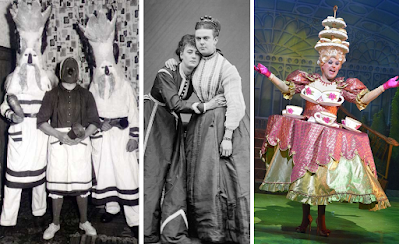
An event in 19th century London about a couple of men renowned for cross-dressing on stage hit the headlines. Their names were Ernest Boulton (1847-1904) and Frederick Park (1847-1881). They have a kind of Christmas connection - Park was baptised on 5th January (Twelfth Night) 1847, probably being born around New Year’s Day, and Boulton was born on 18th December 1847 (his birthday was yesterday).

They performed under the stage names of Stella Graham and Fanny Park and became quite famous. They even had publicity photographs taken of them in their drag costumes. Sadly, because cross-dressing in public in England was illegal at the time the pair were arrested outside the Strand Theatre in London in 1870. This was, however, not the first time that they had appeared in public dressed as women. Both had appeared in court on previous occasions relating to their cross-dressing. They were put on trial for outraging public decency and sodomy. The public followed its progress closely and the courtroom was often overcrowded.

Their first trial dealt with the charge of sodomy. The prosecution insisted that the fact that Boulton and Park were homosexual (a new word at the time) “proved” they were guilty. Many witnesses gave damning evidence against them, though the judge criticised the means by which some of that evidence was gathered. The jury took less than an hour to find Boulton and Park not guilty. This caused great rejoicing in the courtroom and Boulton fainted. A few days later they pleaded guilty to the charge of outraging public decency, thus negating a trial for that offence, and they were bound over to “keep the peace” (a sort of probation) for two years against a fine of 500 guineas. Both returned to the stage and toured in England and the USA, though not together, and not very often in drag.

When Boulton and Park were performing British theatre was experiencing its heyday. It was the period when the modern tradition of British Christmas pantomime (nothing to do with miming) acquired its present form. Some of that tradition came down through the medieval mummers plays. It also evolved out of the Italian “commedia dell’arte” tradition which featured characters like Harlequin, Columbine and Pierrot. Add a big influence from Victorian Music Hall (burlesque) and you get the pantomime that the UK loves to this day.

What people love about pantomime is the comedy, the songs, the spectacle, the slapstick, and above all, the stories and characters. A good traditional pantomime usually has two leading travesti roles, one played by men, the other by a woman. The pantomime dame is the most important. This is always a man in drag, usually a well-known comedian, appearing in ever-increasingly outrageous or elaborate costumes. The travesti dame role first appears way back in 1731 in “Dick Whittington”, my favourite pantomime. Dame roles became more frequent and popular in the final days of Music Hall. Another feature is that the dame has pockets full of sweets and she regularly throws them into the audience, though this has no connection to the Christmas gift-giving of the characters in traditional customs.

Perhaps because of its outrageousness and opportunity to slip in many sexual innuendos the dame character has been played by many gay actors – Sir Ian McKellen, Douglas Byng, John Inman, Wayne Sleep, Danny la Rue, Stanley Baxter, Christopher Biggins, Jack Tripp, Paul O’Grady, the list is endless. Sometimes the dame is the villain, like the two Ugly Sisters in Cinderella.

The other travesti role in pantomime is that of the Principal Boy, always played by a woman. This character is often the hero of the pantomime – Aladdin, Dick Whittington, Robin Hood, Peter Pan, Prince Charming, etc. In recent years, certainly since the 1960s, these roles have often been played by young men, usually the most famous pop star of the day.

So, there you have it. The pantomime dame is a descendant of the medieval Christmas processions and Mystery Plays in which the Virgin Mary was played by a man. The Mystery Plays evolved into mumming plays in which comedy and over-the-top characters helped to inspire the first British pantomimes and the dame.

Examples of travesti (left to right): Weifke (centre) in the Klaasohm custom; a publicity photo of Boulton (left) and Park (right); a typical British pantomime dame.

If we look at the history and development of Christmas and its many gift-bringers we find that there is no single influence or ancestor. What began as a Christian festival has lent its name to many celebrations, traditions and customs held during the Christmas season that have evolved over time. Just like our own family trees, many influences and many people and places have produced what we have today.

This is my final article of 2021. Thank you so much for being with me through this year, and I hope you’ll stay with me in 2022 when we’ll kick off with a list of January birthdays, and in mid-January look forward to the Beijing Winter Olympic and the newest list of lgbt Winter Olympians.

Have a very Merry Christmas and whatever festival and celebration you observe, and a Happy New Year.

Sunday, 12 December 2021

Advent 3: Christmas Can Be a Bit of a Drag

The “family tree” of Christmas gift-bringers that I have been working on, and which I had hoped to present to you today, has proved so much of a tangled web that it is not ready. Perhaps next year?

If you’ve read the previous two Advent articles you’ll know just how much gender confusion there is around at Christmas. This is, as historians remind us, a hangover from non-Christian festivals from the past. I won’t label all of them as “pagan pre-Christian” because a lot of the traditions attributed to paganism were created relatively recently (e.g. the pagan Slavic gods have been proven to be 18th century inventions).

Gender reversal among traditional characters is a common element in many pre-modern customs, both religious and secular. The prominent feature is male-as-female transvestitism. There are, it should be emphasised, many, many traditional female Christmas gift-bringers and characters around the world. Although equally important as their male counterparts they have no gender-queer characteristic, except the ones I’ve mentioned in the previous two Sundays who were primarily transgender in essence – it is the character themselves that changed gender.

There are many regional, Christmas traditions and customs that include male-as-female cross-dressing. From my research I have been able to group them into three categories as follows.

1) The wife of St. Nicholas. We must distinguish St. Nicholas’s wife from the modern Mrs. Santa Claus as established in her present form by Katherine Lee Bates in 1889. The customs in the regions where St. Nicholas is given a wife have no connection to the American Santa Claus. In the article I wrote on Mrs.Claus several years ago I said that St. Nicholas wouldn’t have been given a wife because he was a Catholic bishop. Since then, I have been doing years of research and discovered current traditions where St. Nicholas has a wife in a supporting role. Here are some of them.

Last Sunday I mentioned that in Limburg, Belgium, an incarnation of the gift-bringer St. Barbara under the name of Sinte-Berb came to be regarded as St. Nicholas’s wife. There’s no indication, however, that she has ever been portrayed by a man in drag.

St. Nicholas’s wife appears most frequently in the Christmas customs of the Netherlands, Germany and eastern Europe, usually appearing on December 5th or 6th, St. Nicholas’s Eve and Day. In each case the character of St. Nicholas is portrayed as a medieval bishop similar to the Dutch Sinterklaas, and is most cases his wife is one of a group of companions, both demonic and good. The Nikoloweibl (Nicholas-wife) of the Buttnmandllauf custom of southern Bavaria is one of the good companions, often carrying a basket of sweets to give to children. This custom involves St. Nicholas, Nikiloweibl, an angel and demonic straw men parading through the local villages. They visit people’s homes, perform songs or play pranks, and receive gifts before moving on to the next house. At one time Nikoloweibl was always played by a young man. Today he is often played by a teenage boy in drag, but young women have been welcomed as the saintly wife in some areas since the 1950s. In other areas Nikoloweibl has been dropped in favour of a larger role for the angel, always played by a girl.

Perhaps the most unusual, not to say fun, drag wife of St. Nicholas is Wiefke in the Klaasohm celebrations on the Frisian island of Borkum. Klaasohm means “Uncle Claus” and occurs on December 5th. A group of seven young unmarried male villagers dress in costumes with exaggerated masks, each representing a caricature of St. Nicholas, hence the name. A boy dressed as Wiefke accompanies the senior Klaasohm as the group parade through the village, just like Nikolowiebl does in Bavaria. What distinguishes the Klaasohm custom from all the others is the climax to their parade. The villagers gather in the village square as the Klaasohm and Wiefke climb onto a brick pillar. What they do next is….. well, I’ll let you see for yourself. Here’s a video of the climax to the 2016 “Klaasohmfest”. Wiefke is the character dressed in red.

2) Witches and “perchten”. These are actually two different groups of characters but they share a lot of characteristics and are often interchangeable in some times and places. Perchten is a term used for both good and demonic characters of any gender in traditional winter customs. The term may be related to Frau Perchta, the name of a female deity from ancient folklore who evolved into a child-belly-slitting boogey-woman appearing on Twelfth Night (January 5th).

One perchten-type character based on someone we met last week is the Lucky or Luken of Bohemia and the modern Czech Republic. These female characters are an amalgamation of St. Lucy with St. Barbara, “ancestor” of the veiled Barborka brides played by men in Poland. Once again, tradition says that the Lucky should be played by a man. The Lucky, up to six in number, have different appearances depending on which part of central Europe they occur. Some have white-painted faces, some have long beaked masks. What they have in common are white robes and a broom with which they sweep their way through the streets and into houses. The earliest records of the Lucky, however, describe these women as belly-slitting boogey-women like Frau Perchta.

The sweeping of streets is also a frequent activity in other Christmas traditions. In the town of Rauris near Salzburg, Austria, you can encounter the Schnabelperchten. This is a group of men dressed as peasant women with beak masks and brooms like the Lucky. On Twelfth Night they sweep their way through the houses of the town making bird-like “caw caw” sounds.

Some of the female Christmas characters are more like traditional witches than human-bird hybrids. It is no surprise that these witch characters are perfect for men to portray. In the Trestern custom of Pinzgau, also in the Salzburg area, is a character called Hex. This is a witch who also sweeps her way through houses like her Schnabelperchten neighbour, which makes me think the two characters have a common origin. Nowadays the Hex is often played by someone wearing a Hallowe’en witch mask though originally it was man with witch make-up.

3) General female characterisations. This category includes human, non-demonic female characters. Perhaps the most famous of these is La Befana, one of the principal Christmas gift-bringers in Italy, and yet another character who carries a broom. She could be included in the previous category if it wasn’t for her origin. She is generally depicted as a stereotypical witch today, but originally La Befana (who first appears in the 1500s) was just an old woman. There isn’t much evidence to suggest that she was often played by a man in traditional celebrations, but a modern portrayal of her is worth a mention.

For the past few years on January 6th Venice has held a very special gondola race. It’s part of the Regatta della Befana. Dozens of gondoliers dress up as La Befana and race along the Grand Canal. The winner is the first to grab a sock dangling from the Rialto Bridge full of Christmas goodies. It sounds like great fun, certainly more fun than the Oxford and Cambridge Boat Race in the UK.

There are quite a few female characters that are more “normal”. As well as Hex in the Pinzgau Trestern there is Lap and Lappin, a married couple, both played by men. Sadly, they have traditionally been played as a couple with intellectual disabilities, and Lappin is always portrayed as pregnant.

Among other female characters in traditional Christmas customs played by men are: Zusslweibl in the Klöpfeln custom from the Italian Alps, appearing on the three Thursdays before Christmas; Jumpfere the virgin in the Bärzeli-Buebe custom of the Hallwil in Switzerland (also home of the Wienachts-Chindli I mentioned last Sunday), appearing on January 2nd; and the Huttfroueli, an old woman who appears in several local customs in the Alps, appearing between Christmas Day and New Year’s Day.

One final entry into this group is another Alpine character. In various Swiss towns on either New Year’s Eve or January 13th groups of men dress up as various characters, the Silvesterklaus. They go from house to house, singing, yodelling and wishing everyone a Happy New Year. Among the Silvesterklaus is a character played by men, the Schöne. The name means “beautiful”, and the men put on traditional female Swiss costumes and wear masks of a young woman’s face with a large, elaborate, and very heavy headdress.

But what about women dressing as male characters? While the majority of the cross-dressing roles have been men in drag there have been a few instances in modern times of women playing male roles. As mentioned above and last week, the instances of women playing the Christkind came about because the gender of the character itself changed from male to female. Instances of women playing male characters have increased in recent years, particularly as one of the most controversial Christmas character of our time, Zwarte Piet.

Discussing and analysing the racism attributed to Zwarte Piet, the black-faced companion of Sinterklaas, is outside the scope of this blog. What these accusations, modern interpretations of race that have no relation to the historical development of the character, have forced the Dutch to question Piet’s inclusion in Christmas festivities. In a lot of places a compromise has taken place. Instead of Piet appearing in black face he has begun to appear in red-face, green-face, blue-face, and any other colour. At the same time more women are playing Piet, and the traditional male name and gender of the character is generally retained. A similar change is beginning to occur in portrayals of the demonic Krampus. With the increase in the worldwide appeal of the character more women are beginning to dress up as a new character, a female Krampus, in traditional European festivals. Krampus has always been regarded as a male demon. Both the Krampus and Piet are instances of a traditional character evolving before our very eyes.

Who knows which of the Christmas characters we love today will remain the same in a hundred years. Who knows what influences will change them, and who knows which new characters will appear as a result. Will the current cultural climate of increasing recognition of gender diversity and racial representation have any effect?

But, let’s go back to antiquity next week and look at the history and development of the tradition of men playing women in festivals and theatre to see why this is so, and look at the version that is hugely popular in the UK at Christmas time.

Friday, 19 February 2021

Star-Gayzing: The Drag Queen's Crown

Most of the myths and legends concerning the origins of the constellations come from ancient Greece. The majority of those I’ve covered on this blog have been Greek. Today we look at yet another one.

Some of the most famous and popular Greek gods and heroes – Zeus, Apollo, Herakles/Hercules, etc. – have several constellations associated with them. One of the others, whose name doesn’t often spring to mind immediately when asked to name the Greek gods, is Dionysos. He was the god of wine, vegetation, fertility, pleasure, mischief, parties – and drag queens.

I’ve mentioned Dionysos twice before in relation to the stars. First was his association with Virgo, in particular with the star Vindematrix. This name means “grape gatherer” and its rise in the sky signalled the start of the grape harvest. The other constellation with Dionysos connections is Taurus, or more specifically the group of stars within it called the Pleiades. These stars were named after the seven daughters of Atlas who, as I mentioned in the article about them, seem to have been the patron deities of drag queens. Briefly, without going through it all again, ancient astrologers believed that the Pleiades influenced the worshippers of Dionysos, turning them into what the ancient writer Manilius described as someone remarkably similar to a modern day drag queen. In mythology the Pleiades raised Dionysos and disguised him as a girl to protect him from the wrath of Hera, the ever-jealous wife of Dionysos’s father Zeus.

So, what about that drag queen’s crown, you may be asking? Well, the constellation of Corona Borealis is said to represent a crown given by Dionysos to one of his lovers. Not one of his male lovers but a female one called Princess Ariadne of Crete. This princess may be familiar to you from the legend of Theseus and the Minotaur. In the main variation of the myth, the most familiar one, Theseus and Ariadne got married after the Minotaur was defeated and they returned to Athens, Theseus’ home. Apparently, the marriage wasn’t a very good one and legends vary on who left who (or is it who left whom? I’m never sure about my grammar). Whichever partner it was who deserted the other first, Ariadne ended up being courted by Dionysos who had always wanted to get her into bed with her. Again, the myths vary here. The crown was either given by Dionysos as a symbol of his love before they got married, or a gift to Ariadne on their wedding day.

There’s yet another version of the myth. Theseus had not entered the labyrinth to confront the Minotaur when Dionysos gave the crown to Ariadne. It shone so brightly that she gave it to Theseus for him to see his way in and out of the labyrinth. The most familiar version has Theseus following a thread which Ariadne was holding. On Theseus’ emergence from the labyrinth Ariadne threw the crown into the sky and it became the constellation.

Whichever version was told in ancient Greece the end result was always the same – the crown ended up as Corona Borealis.

While I’m on the subject of Dionysos there’s an old fable that was recounted by the famous story-teller Aesop over two and a half thousand years ago. In it Dionysos has a significant influence on the creation of gay men and lesbians.

The god given the responsibility of creating mankind was Prometheus. He used clay to form the original bodies, making hundreds of thousands of them, men and women. This took him many days. For some reason they were all created without sexual organs, and Aesop doesn’t tell us why. When Prometheus had finished he began to form the male and female sexual organs separately. Again this took many days. He began to attach the sex organs to the pre-formed people. This also took many more days and Prometheus was getting more tired by the minute.

At that moment Dionysos arrived to ask Prometheus out for a drink. Prometheus was reluctant at first because he had this job to finish, but Dionysos keep nagging him to leave the job till later. He needed a rest and a drink would refresh him. Prometheus relented and off the two gods went.

Now, we all know what sort of relaxation Dionysos was keen on – a good party with lots of alcohol. So Dionysos took Prometheus away and they had a jolly good night out filled with wine and nectar.

Eventually Prometheus decided it was time he got back to work. He staggered home in a drunken stupor and sat down. What was he doing, he probably thought? Oh yes, putting the genitals on the rest of those human figures he had made. Picking up the genitals, one by one he began attaching them to the figures.

It was only when he had finished that he realised he had mixed up that last lot of genitals. On all of the figures he had worked on since coming home from his night out with Dionysos he had put the wrong genitals on the wrong gender. The men had female genitals and the women had male genitals.

This is how Aesop explained the creation of men and women who display characteristics of the opposite gender – effeminate men and butch women. Effeminate men were female forms with male genitals, and butch women were male forms with female genitals. It was Aesop’s way of explaining gay men and lesbians.

So, if you’re ever asked if homosexuality is “nature or nurture” you can say neither. It’s the result of a drunken night out with a drag queen!

Friday, 15 November 2019

Indulging in the Sisters' Anniversary

Among the high-profile anniversaries of 2019 is another which has had little attention outside the USA. That is the 40th anniversary of the formation of the Sisters of Perpetual Indulgence. Its members have a highly visible and recognisable presence in the lgbt community and it is only proper that I “indulge” in their celebrating their 40 year service and devotion to lgbt causes.

What I find particularly interesting about the origin of the Sisters of Perpetual Indulgence is how much the anti-clerical parody and satire of its original purpose echoes the anti-clerical parody and satire of medieval French performing troupes. These French performers went on to inspire the Mattachine Society, the America gay rights organisation of the 1950s which I wrote about earlier this year.

Perhaps unknowingly the founders of the Sisters of Perpetual Indulgence became part of this long tradition of masked or disguised satirist groups. The use of white-face make-up by the Sisters is a direct parallel of the masks worn by those medieval French performers.

On 17th September 2012 I wrote briefly about three members of the Sisters of Perpetual Indulgence. Today we’ll have a look at the origins of the Sisterhood.

The main centre of activism by the first Sisters may have been in San Francisco but their roots go halfway across the USA to Iowa.

In the mid-1970s at the University of Iowa Kenneth Bunch was a gay activist and publisher of “Radical Faery magazine” (the Radical Faeries were another early lgbt group). Kenneth also founded a small performance group called the Sugar Plum Fairies. At one of their planning meetings one of the Sugar Plums happened to mention that she knew the Mother Superior of a convent in Cedar Rapids and that she was sure she could persuade her to loan the group some nuns’ habits for some of their drag performances. Of course, the subject of drag wasn’t mentioned to the Mother Superior. Instead she was told they were for an amateur production of “The Sound of Music”.

Having acquired the nuns habits the Sugar Plum Fairies began performing around Iowa. This was an unusual sight in drag, as you might expect, as most drag performances at the time were dominated by classic diva tribute acts – Judy Garland, Edith Piaf and 1960s stars like Diana Ross. The sight of drag nuns in a pompom routine really stirred things up.

The white-face make-up characteristic of the Sisters of Perpetual Indulgence came through a different route.

In Iowa City Kenneth Bunch had a room-mate who was a photographer. Now and again they would indulge in the fashionable habit of taking drugs and Kenneth would then dress up and put on white make-up. His room-mate would then photograph him. For Kenneth these photos proved to be vitally influential because they appeared more dramatic and expressive than photos of him without make-up. Again, perhaps unknowingly, Kenneth had latched on to the original reason why clowns have such distinctive white make-up.

Fast forward to 1977 and San Francisco. Kenneth had now moved from Iowa and was turning into what known as the San Francisco “clone”, a denim and leather-clad macho stereotype that was becoming fashionable.

Kenneth persuaded an old activist friend from Iowa, Fred Brungard, to move to San Francisco and share a house with him. Kenneth was realising the clone look was becoming conformist so he persuaded Fred and another friend, Baruch Golden, to liven up the Easter weekend of 1979.

Just about the only drag-related items Kenneth brought to San Francisco with him from Iowa were the nuns’ habits. He was moving away from drag and towards the clone look and for some reason decided only to keep the nuns habits.

And so, on Easter Saturday, 14th April, 1979 Kenneth, Fred and Baruch decided to go into the gay quarter of San Francisco dressed a nuns. Kenneth was the only one with white-face. The sight of these “nuns” created quite a stir and so the soon-to-be-named Sisters of Perpetual Indulgence made their first appearance in public and went on to inspire thousands of others in the years that have followed.

Of course, the Sisterhood didn’t form directly out of that Easter Saturday appearance. There was another appearance by Kenneth Bunch and another friend, Edmund Garron, which created some disruption to the annual softball match between the Gay Softball League and the San Francisco Fire Department the following June.

It was only when Kenneth, Fred, Baruch and Edmund decided to move in together that the idea of a Sisterhood was discussed. The flat they shared on Ashbury Street became known as “The Convent” and was the venue for the first meetings of the newly-named Sisters of Perpetual Indulgence.

And they’ve been perpetually indulging in their activism, fund-raising, charity work and performances ever since. Many Orders, both in the USA and around the world have created a unique and highly recognisable element to the lgbt community. Happy 40th Anniversary Sisters.


I shall be back in December with four articles on each Advent Sunday looking at four types of Christmas decoration and their lgbt links, and ideas on how to make your own last minute decorations based on them.

Thursday, 27 February 2014

Dragging It Out With Music

On Tuesday night I joined my colleagues on the Nottinghamshire Rainbow Heritage project at the council house in Nottingham for our annual celebration of LGBT History Month. Part of the celebration featured a performance by two members of a local energy company who entertained the capacity audience with their drag double act. It’s highly appropriate that drag cabaret formed part of the celebration because, as I’ve mentioned before, Nottingham was the home city of one of the UK’s most famous drag performers and cabaret artists of the 20th century – Douglas Byng (1893-1987).

Douglas Byng features a lot in my lgbt tours of Nottingham. There are plenty of stories about him that I can use, not all of them on the same tour. For today I want to pull some of these together into one article.

We’ll start with his birth – where else? Douglas wasn’t born in the city centre but in a suburb called Carrington about a mile away, too far away to actually take the tour on foot. His father Joseph Byng was the manager of the Nottingham Joint and Stock Bank which was in the city centre just behind the council house. The bank is now a branch of the French Connection fashion store. I explain on my tours a little about Douglas’s family background in front of this store, of how appropriate it is that Douglas became interested in fashion, and how Joseph and his first wife and 10 children lived in an apartment on the top floor. After the death of his wife the family moved out to a new house in Carrington, where Joseph lived with children and his 2nd wife, and where Douglas was born.

The road out of the city centre to Carrington is called Mansfield Road. At the end of the Victorian period and into the start of the 20th century this road was the place to be seen on a Sunday afternoon. After church and Sunday lunch people would dress up in their finest and walk up and down Mansfield Road (its quite a long road) during what was called the Sunday Parade.

While he was still a youngster Douglas decided he’d take part in this Sunday Parade. Wearing a wig made from hemp matting, a purple overcoat and a tall cane he strolled up Mansfield Road and back down again. He waved to passers-by and greeted imaginary friends, and then encountered a very real neighbour who recognised him. Douglas was deeply embarrassed at being discovered and never took part in the Sunday Parade again. Considering this is now the route of the annual Nottingham Pride march from the city centre to the Pride site it seems that Douglas wasn’t the last gay man to dress up and be noticed on Mansfield Road.

This interest in dressing up didn’t impress Douglas’s parents, however. They sent him off to live with his eldest brother in Germany in an effort to curb his enthusiasm for theatrics. There Douglas studied music which would become a vital part of his later career in cabaret. Also putting the kibosh on his parents’ intentions Douglas grew more interested in costume as his brother owned a lace factory (Nottingham was a leading lace-making centre at the time and it’s lace-makers were in demand around the world).

Douglas returned to England before the First World War and began his career as a theatrical costume designer. In 1914 he took to the stage himself in a seaside concert party. He first appeared in pantomime in 1921, and in 1924 played his first Dame role in “Dick Whittington”. For those unfamiliar or confused by British panto the Dame is a comedy role played by a man in drag, usually quite grotesque or eccentric in character. It was in the Dame role that Douglas was to make his name in the 1930s and it enabled him to use his design skills to create ever increasingly outlandish costumes, something that has now become essential in British panto.

Dames had previously been played “straight” as men dressed as little old ladies (think of Old Mother Riley, or a comedy version of Norman Bates from “Psycho”). Douglas brought more fun, imagination, and indeed glamour, to his costumes, often parodying the fashion of the time. In the 1930s there was a fashion for short fox-fur capes complete with rows of fox tails. My grandmother had one, it was creepy!

Douglas parodied these capes by designing one made out of bathroom loofahs instead of fox tails. It presented problems a couple of years later when World War II broke out because loofahs were imported, and they became difficult to obtain. Douglas realised that his loofah cape was in danger of being stolen. There were plenty of Black Marketeers who’d think nothing of stealing it and selling the loofahs at a profit. So Douglas decided to lock the cape away in a safe when it wasn’t needed for performances. Needless to say, this made the cape more valuable than the real fox-fur capes, and a valuable asset.

Douglas performed in Nottingham several times in pantomime at the Theatre Royal, another stop on my tours. After retiring to Brighton on the south coast he still visited Nottingham to see his siblings, several of whom lived well into their 90s, and a brother who died in 1983 at the age of 103. Douglas himself died at the age of 94.

To end this article I’ll show you this video of Douglas Byng in action doing one of his cabaret acts. It’s not very crisp in either sound or vision I’m afraid. Rather than appear in full drag as he did in his usual cabaret act, Douglas gives the suggestion of drag with a few simple items of clothing in this old film from 1932.

Wednesday, 14 August 2013

Star Gayzing - Interstellar Fag Hags and Drag Queens

For those of you who aren’t sure, a “fag hag” is a straight woman who spends a lot of time in the company of gay men, especially out clubbing and partying. There is one group of stars which, according to some authorities, have been associated with homosexuality since Ancient Rome, but I prefer to think of them as the “Interstellar Fag Hags”. This group of stars are the Pleiades in Taurus.

The Pleiades of Ancient Greek legend were 7 sisters, daughters of Atlas and the sea-nymph Pleione. There are several legends regarding their transformation into stars. First, one says how they mourned the deaths of their half-sisters the Hyades and committed suicide en masse. Zeus turned them all into stars. Another legend says the Pleiades killed themselves after their father was doomed to carry the weight of the sky on his shoulders. Yet a third says that Zeus turned them into stars to escape the attention of Orion. In the night sky, the constellation of Orion appears to chase the Pleiades across the sky.

Many astrologers say that the Pleiades were associated with homosexuality in ancient times, but as yet no-one has discovered why. One clue, however, can be found in the 1st century poem called “Astronomica”. The poem’s author, Manilius, was writing in an era when astronomy and astrology were indistinguishable. In contrast to today’s astrology, Manilius wasn’t interested in the planets and their influence, only the constellations (both zodiac and non-zodiac).

What Manilius wrote about the Pleiades was : “Under their influence devotees of Bacchus and Venus are born into the benevolent light, and people whose carefree and irresponsible behaviour runs free at parties and banquets and who strive to provoke good humour with biting wit. They will always take pains over personal adornment and elegant appearance. They will set their long hair in waves or curls or confine their tresses with ribbons, building them into a big topknot, and they will transform the appearance of their head by adding hair to it; they will smooth their hairy limbs with pumice, loathing their masculinity and craving for sleekness of arm. They adopt feminine dress, footwear worn not for practical use but for show, and an affected feminine walk. They are ashamed of their sex; in their hearts dwell a senseless passion for display, and they boast of their malady, which they call a virtue. To give their love is never enough, they will also want their love to be seen” (adapted from the translation by G. P. Goold, 1977, Loeb Classical Library edition).

Manilius was writing during the Roman period and used the Roman names of the gods. Bacchus was the Roman equivalent of the Greek god of wine, dance and theatre, Dionysos. Dionysos was considered a bull-god, the bull being an important symbol of power and male virility. This may be the reason who the Pleiades and Hyades star clusters are in the constellation of Taurus the Bull. Taurus may represent Dionysos the bull-god, and the Pleiades and Hyades were said to have been his nursemaids and teachers. Taurus has other bull-related symbolism, as told in an earlier Star Gayzing article in March 2012.

Dionysos was also regarded as a god of sexual opposites – a fertility god who was never shown sexually aroused, a powerful male god who dressed as a woman, a god of equal masculine and feminine qualities. Many sources called Dionysos “womanly”, yet his myths always represent him as quite definitely butch. Only very early representations of his show him as a long-haired androgynous beardless youth.

What helps to understand why Dionysos should wear woman’s clothes is one of the myths about his childhood. Rather than be brought up by the Pleiades and Hyades, Dionysos, who was an illegitimate son of Zeus, was put in the care of King Athanus who was told to raise the boy as a girl to hide him from the wrath of Hera, Zeus’s wife.

The adult Dionysos didn’t need to be shown sexually roused as he was often surrounded by spectacularly well-endowed satyrs and attendants. Being sexually aroused was seen as being bestial, not godly. Besides, Dionysos’s own son, Priapus, is the epitome of perpetual sexual arousal!

The Bacchae, the wild parties held as part of the worship of Dionysos/Bacchus, are characterised by their  descent into orgy. In Ancient Greece these often involved same-sex activity, as was accepted in their society.

Reading Manilius’s text again it would appear that he was not so much describing cross-dressers but drag acts – the female attire, the effeminate manners, the over-the-top personality, and the “strive to provoke good humour with biting wit”. He appears to be describing the Pleiades as a gods who influence men to turn against the usual male stereotype and to act and dress as women. Perhaps we could call the Pleiades a constellation for fag hags and drag queens. And, of course, drag queens refer to each other as “sisters”.