Showing posts with label parliament. Show all posts

Tuesday, 4 March 2025

City Pride - Sydney

Following on from the Venice carnival we arrive at the actual day of Mardi Gras. For those who are unfamiliar with the origin of Mardi Gras, perhaps a little information may help. In medieval times Christians put aside several weeks of fasting and abstinence before important Christian festivals like Easter and Christmas. The most common terms for these periods are Lent and Advent respectively. Lent begins tomorrow, the day after Mardi Gras. In preparation, Christians would eat up all the food that they were going to deprive themselves of all the way up to Easter, especially meat. They would also celebrate with carnivals. Actually, “carnival” comes from a 15th century Italian term meaning “remove meat”, which implies the word was created specifically for Christian Mardi Gras celebrations. Today people have generally dropped the fasting element.

Perhaps the most famous Mardi Gras carnivals take place in Brazil and New Orleans, but undoubtedly the most famous lgbt+ Mardi Gras is that held in Sydney, Australia. This year’s Sydney Mardi Gras finished this past weekend. So, as a belated celebration, here is the latest entry in my “City Pride” series about Sydney.

The area I’ve concentrated on is just south of Sydney Harbour Bridge. Because Sydney has so much lgbt+ history it has been difficult to narrow it down to just 12 locations. Most of them may be known to a lot of Sydney citizens, but I have, as always, tried to find some lesser known locations, people or events that show the diversity of the lgbt+ culture in Sydney.

First of all, the area covered is in the Sydney Electoral District (except for a tiny bit of the bottom left hand corner of the map). The current MP for the Sydney electoral district in the New South Wales parliament is Alex Greenwich (b. 1980, into a princely dynasty from Georgia – the country, not the US state), who has been the representative since 2012. He was the first openly gay elected member.

The locations are listed from north to south.

1) Speaker’s Corner, The Domain

John Webster (1913-2008) was a regular speaker at Speaker’s Corner for over 30 years. His distinctive voice is remembered by many older Sydney citizens of all political ideologies, genders and faiths. His opinion on all these issues evolved over the years. Briefly married twice, he is also known to have had gay relationships. His ashes were scattered around the Speaker’s podium.

2) St. James’s Church

In the summer of 1836 Rev. William Yate (1802-1877), a British missionary fresh from New Zealand, was appointed chaplain to this church. It was while he was here that reports were made to the authorities of his homosexual activity with sailors and Maori youths. Yate protested his innocence, and no evidence of actual sodomy was proven. Nevertheless, he was dismissed and was sent back to the UK by December. He took with him Edwin Denison, the Third Mate he “befriended” on the ship that brought him to Sydney. He died as chaplain of the Mariners Church in Dover.

3) Sydney Town Hall

One of the locations that were part of the demonstrations that took place in Gay Pride Week 1973. On 15 September activists marched to the hall. Among the banners they carried was what I consider to be the world’s first lgbt+ community flag – a black flag with a pink triangle in the centre. Previous flags had belonged to specific organisations, but in Sydney this flag was adopted by all sections of the community. I write in more detail about the use of this flag here.

Currently, there are a record four lgbt+ elected members on the city council, Zann Maxwell, Matthew Thompson, Mitch Wilson and Adam Worling, all elected last October. Zann Maxwell was appointed the city’s Deputy Mayor.

This year is the 25th anniversary of the Sydney Olympics. At the end of each day of the torch relay there was a ceremony involving the lighting of a “community cauldron”. On the night before the opening ceremony the final leg of the relay went from Sydney Harbour Bridge and down George Street to the Town Hall. The last torch bearer was the world’s top female golfer at the time, Australia’s Karrie Webb, who lit the community cauldron.

4) St. Andrew’s Cathedral

One of the few non-political Australian state funerals took place here in 1986. It was to honour the Australian ballet dancer and choreographer Sir Robert Helpmann (1909-1986). He is most famous for his role as the Child Catcher in the film “Chitty Chitty Bang Bang” (a character invented for the film). Helpmann was the first in a long line of openly lgbt+ performers to play this character in its many theatre productions. These include Stephen Gately, Wayne Sleep, Paul O’Grady, Richard O’Brien, and The Vivienne.

5) Junction of William Street and College Street, Australia Museum

During WorldPride 2023, hosted by Sydney, many artistic expressions of lgbt+ culture were on display. One of the most unusual, located outside the museum entrance, was the Progress Shark, a huge life-size model of a great white shark dressed in a Progress Flag-inspired lycra swimsuit. Created by Sydney-based artist George Buchanan, the shark quickly became a tourist attraction and icon of WorldPride. Like many artworks created for the occasion it was taken down afterwards.

6) 110 Bathurst Street

This is currently a modern multi-storey building home to various businesses, but back in the 1920s it was a residential area. This address was, for a couple of years, the art studio and salon of Australian sculptor and artist Dora Ohlfsen-Bagge (1869-1948) and her partner Baroness Helene von Kügelgen (d.1948). Although they lived in Rome most of the time, Dora revisited Sydney and produced many works for Australian clients. These included designing the ANZAC medal, and many sculptures that are now lost or destroyed.

7) 29 Pelican Street

In 1948 this address became the home of Iris Webber (1906-1953), described by local newspapers as “the most violent woman in Sydney”. She is a perfect subject for one of my “Extraordinary Lives” series. Condensing her life down to a few sentences has been difficult, but here goes. Iris was married twice and had at least two female partners. She shot three men (including her first husband, and killing another) but was acquitted each time. She was either arrested or convicted of assault at least 4 times (twice with a tomahawk). She was arrested many times for busking and begging, illegally selling alcohol, and robbery (with her then partner Vera). Iris’s last court appearance was for contempt of court in 1952.

8) National Art School, formerly Darlinghurst Gaol.

This old jail once housed several notable lgbt+ prisoners, the most well-known being the bushranger known as Captain Moonlite (Andrew Scott, 1842-1880). Born in Ireland, Scott can be said to have been a bit of an adventurer, travelling the world fighting as something of a mercenary before arriving in Australia in 1867. While living as a lay reader in a church in the gold fields, he was masquerading as Captain Moonlite, robbing a local bank agent. Caught and convicted, Scott met James Nesbit in jail and the two formed a relationship. After release he struggled to find work, and attacked a cattle station with his gang. Nesbit was killed, but Scott was captured and later hanged in the jail.

The current art school opened in 1921 has had many lgbt+ alumni and has hosted many exhibition by lgbt+ artists.

9) Green Park – LGBT Holocaust Memorial

This monument, designed by Jennifer Gamble and Russell Rodrigo, commemorates the many lgbt+ victims of the Nazis during the Holocaust. The pink triangle that gay prisoners were forced to wear has become an iconic symbol of gay rights in the 1970s. The Jewish Museum is located across the road to the north on Burton Street. In this year when we remember the 80th anniversary of the end of World War II it is essential we recognise diversity of opinion by people on all sides, without anger, hatred, or violence.

10) 301 Forbes Street – Qtopia

Sydney’s first permanent lgbt+ museum, said to be the world’s biggest, opened here in February 2024 in buildings that were originally Darlinghurst’s police station. As the police station it was where people arrested on homosexual charges were held in custody. This included a large number of participants in Sydney’s first Mardi Gras in 1978, people who proudly sport the name of The 78ers. Sadly, a sign of the times included police brutality against those in custody. The museum also has sections on AIDS, and a reconstructed AIDS ward from the neighbouring St. Vincent’s Hospital where many AIDS patients were treated.

11) Junction of Campbell Street and Little Bourke Street

On the night of 31 March 1962, the body of Frank McLean was discovered several metres south of this junction. He was one of several gay victims of William MacDonald, whom the media labelled as “The Mutilator”. MacDonald picked his victims up in gay venues, took them to a private location and murdered them, slashing their bodies and severing their genitals. He was sentenced to life imprisonment and died in 2015.

12) Taylor Square – The Rainbow Crossing

Sydney’s famous crossing was first established in 2013 for that year’s Mardi Gras. However, due to concerns that people standing on it to take selfies put them in danger of being run over, the city removed it. This sparked as spate of graffiti chalk rainbow crossing popping up across the city in protest. Thankfully, the city council realised the importance of such a statement of identity and repainted crossing in 2019.

Thursday, 8 July 2021

William and John: Part 3) William at Court

After looking at Sir John Clanvowe’s military career we turn today to the court career of his partner, Sir William Neville.

First of all, let’s look at Sir William’s marriage. It wasn’t what you could call a “marriage of convenience” as it might have been described in the 20th century, in which a marriage was arranged to hide the sexuality of one of the partners. Men we would regard as gay today would often marry and have children in pre-modern times. They didn’t think there was anything was wrong with that.

Sir William’s marriage was more of a political and financial marriage. As I mentioned in Part 1 when I described the childhoods of Sir William Neville and his male partner, William had little chance of inheriting substantial property or an income from his father, being the youngest of five sons. After plans for William to inherit the estates of his step-brother, Lord Greystoke, fell through, Lord Neville arranged for him to marry the heiress of manors spread across Yorkshire.

In 1366 William married Elizabeth le Waleys, the younger of the two daughters and coheirs of Stephen le Waleys, 2nd Baron Waleys. The elder daughter, Anora, died childless within two years and Elizabeth became sole heir to the family estates and "de facto" Baroness Waleys. This meant that William Neville now had an independent income and property through his wife (all property of a married woman usually belonged to the husband in those days). Elizabeth le Waleys was as well connected as her husband. Her father’s step-brother was the famous Robert the Bruce, King of the Scots.

As mentioned in part 2, Sir William Neville spent some time in France serving with the army during the Hundred Years War. When he returned to England he began a distinguished career at court. By this time his eldest brother Lord Neville, who had inherited their father’s title, had obtained the position of Lord Steward of the King's Household in late 1371. Probably through his brother's influence, Sir William succeeded his brother as Admiral of the North in 1372. This was one of the top naval commands in England. As Admiral of the North Sir William was responsible for all the fleet and ports north of the River Thames and naval activities in the North Sea.

In 1373 Sir William temporarily commanded the southern fleet that was appointed to patrol the Norman and Breton coasts and protect the English possessions there. Sir William anchored his fleet at St. Malo for several months and then he was called upon to go to the aid of his brother, Lord Neville. Lord Neville had been appointed ambassador to Brittany in June 1372 in order to negotiate an Anglo-Breton alliance. Brittany was subject to the French crown even though it was English support that had put the Duke of Brittany in power, as explained last time. The resulting alliance, not welcomed by the Breton lords, led to renewed rivalry between England and France. Lord Neville was appointed Captain of Brest and was given command of an English force. The French, under Bertrand du Guesclin, invaded Brittany and laid siege to Brest Castle. Lord Neville was accused of not providing sufficient military defence which led to the siege. This would taint Lord Neville’s reputation and be used against him three years later.

Lord Neville hoped that the army being assembled by Prince John of Gaunt, destined to form the "Grand Chevauchée" (see Part 2), would come to his aid. The army helped to keep the French at bay only temporarily. Sir William Neville's fleet carried an army which reinforced and restocked the Brest garrison. The Grand Chevauchée distracted some French forces away from Brest, but several other garrisons were still taken from the English.

By 1376 the war with France was not going well and people were putting some blame onto Lord Neville. As Lord Steward of the King’s Household he was also accused of helping the Lord Chamberlain to embezzle public funds. Later that year both the Lord Chamberlain and Lord Neville were impeached by parliament, even though the actual evidence of embezzlement against Neville was flimsy to say the least. This “Good” Parliament, as is it known, was called to address the many growing suspicions of corruption among the chief ministers of the old and frail King Edward III. The "Good" Parliament only deepened divisions, both at court and in the country. Sir William Neville seems to have escaped any suggestion that he profited from his brother's alleged actions. However, he was removed from his appointment of Admiral of the North in the same month as the impeachment. It wasn't long, however, before Lord Neville was reappointed Lord Steward by Prince John of Gaunt, who had by now become the chief minister of the country.

King Edward III died on 21st June 1377. His grandson Richard, Prince of Wales, succeeded as King Richard II at the age of 10. Sir William Neville had been appointed to the household of Richard just six months earlier. The succession of a 10-year-old boy as king led to politicians and royal relatives vying to ensure that the king's voice was theirs. Richard's own voice on matters was hardly ever heard, but he was personally responsible for the decision to keep Sir William Neville in his service after his accession, perhaps even making him a Gentleman of the Chamber at that time also.

By 1378 both Sir William Neville and Sir John Clanvowe were favoured members of King Richard's court. Both were King's Knights and in regular attendance on Richard. They had become members of an inner circle of friends which the young king gathered around himself. Their positions of trust was recognised by their additional appointments as Knights of the Chamber by 1381. This brought them even closer to the king than the Privy Council and indicates how much King Richard must have trusted in their confidence.

A few historians believe that by this time Sir William and Sir John had formed a close personal bond. On John's return from the French wars they would have had ample opportunity to meet at court. As the years passed their names appear together in court records more and more often, and chroniclers of their time even begin to acknowledge an unusually close bond between them. They continued to have their separate lives and appointments; Sir William and his wife Elizabeth with their estates in Yorkshire and Nottinghamshire, and Sir John with his appointments in Herefordshire and the Welsh borders. But they always managed to be together at court sessions and as the King’s Knights of the Chamber, which would be for six weeks at a time on a regular basis.

During their time at King Richard’s court they would have mingled with the other courtiers, and that included the famous poet Geoffrey Chaucer. He became a close friend of both Sir William Neville and Sir John Clanvowe. It was through this friendship that Chaucer and Sir John came up with the idea of St. Valentine’s Day as a day of romance, something that had not happened in history before. The story of how they created it is told here.

It was also at about this time that Sir William Neville acquired his connection to Nottingham Castle and Sherwood Forest. In Part 4 I’ll delve further into their time in Nottingham and how I believe Sir John Clanvowe came up with the oldest surviving ballad featuring a hero well-known across England at the time – Robin Hood.

Wednesday, 17 March 2021

Paddy Power

Happy St. Patrick’s Day. This is one those religious feast days that has become very a popular secular celebration. Most people don’t care who St. Patrick was as long as he gives them an excuse to get drunk.

Millions of us with Irish ancestry (my great-grandmother was Irish) will be celebrating all things connected to the Emerald Isle today, though sadly without the St. Patrick’s Day parades.

There’s quite a history behind the lgbt community and the various battles to be included in St. Patrick’s Day parades, especially in the USA. There’s isn’t enough space to go into the full history here, but if you’re interested here’s a brief timeline of the difficulties lgbt groups have had in trying to join New York City’s parade. Other US cities have been welcoming lgbt paraders for several years.

Anyway, this should be a day to celebrate. So are seven lgbt “Paddies” who have made their mark of the community and the world. The legacy of most of them has come at a high price, however.

1) Oscar Wilde (1854-1900) – I couldn’t really list any lgbt Irishman without including Oscar Wilde. However, his influence is gradually fading within the lgbt community because each new generation has newer role models and heroes to commemorate. I’m sure some famous gay men were forgotten after Oscar Wilde hit the headlines due to his involvement with Lord Alfred Douglas. That’s where historians have a vital role to play – to resurrect and raise awareness of forgotten or overlooked people and events that have all helped to build our community. Oscar still exerts his influence among the older generations. In December he was back in headlines when plans were revealed to turn Reading Gaol, where he was imprisoned for gross indecency, into luxury apartments. Many British “A” list actors are campaigning to prevent this from happening. If memory serves, the gay activist Peter Tatchell once suggested that Reading Gaol would be the perfect site for the UK’s first permanent lgbt museum – if only he’d put his money where his mouth was. I take consolation in knowing that the door to Oscar’s cell will be saved – it’s currently part of the collection at the National Museum of Justice here in Nottingham.

2) Arthur Gore, 7th Earl of Arran (1903-1958) – Although English by birth the Earl of Arran held an Irish title and came from a distinguished Irish dynasty. He inherited his title from his father in 1958 but didn’t take his seat in the House of Lords because he committed suicide 28 days later. It is generally believed that personal struggles over his homosexuality was the reason. He was succeeded by his brother, a Liberal Party peer, who introduced the Sexual Offences Bill into parliament in 1965. Despite the majority Labour House of Commons voting against it twice (the Labour Prime Minister didn’t support it) the earl’s bill made its third successful passage through parliament to become the Sexual Offences Act 1967 which partially decriminalised homosexuality in England and Wales. This is seen as a landmark in gay rights and may never have made it through parliament without the 7th Earl’s brother pressing for a change in the law. Sadly, other people (i.e. the Labour Party, as usual) took the credit.

3) Declan Flynn (c.1952-1982) – Just as the murder of Harvey Milk gave impetus to the San Francisco lgbt community the murder of Declan Flynn gave impetus to the community in Ireland. Declan worked at Dublin Airport and was a volunteer at the city’s gay resource centre. On 9th September 1982 Declan was walking home after a night out with a friend. As he walked through Fairfield Park he was attacked by five teenagers who beat him to death with sticks. The murderers were quickly caught and put on trial. They all admitted to the killing but the judge, to everyone’s surprise, even the killers’, gave them all suspended sentences. A debate was held in parliament on the verdict. On 19th March 1983, eleven days after the sentencing, a protest march through Dublin was organised by the lgbt community and many supporters and allies. It was the largest gay rights demonstration seen in Ireland up until then. It inspired the relatively small Dublin Pride, which had been in existence since 1974, to form the first Dublin Pride march several months later. Declan Flynn is still remembered in the community, and the bridge in Fairfield Park which bears a memorial to him was decorated when Ireland passed their same-sex marriage act in 2015.

4) Lyra McKee (1990-2019) – Mention the name Northern Ireland to people of my generation and a subconscious image comes to our minds of “the Troubles”, the conflict between Irish republican militants and the British authorities who between them caused the death of hundreds of people. Even though “the Troubles” were officially resolved peacefully several decades ago there are fringe militant groups who still occasionally bring terror to Northern Ireland. In April 2019 lesbian journalist Lyra McKee was covering a militant republican protest in Derry when she was hit by a bullet. She later died in hospital. One of the militants was charged with her murder. Condemnation came from all sides and many nations and Lyra’s death was made more tragic when it was revealed that she was going to propose to her partner that week. Lyra’s death served as a reminder that violence and militancy are around us all the time and more determined efforts were made to keep peace in Northern Ireland.

5) Michael Dillon (1915-1962) – Physician, writer and Buddhist monk Michael Dillon is one of the pioneers in the British transgender community. In his early 20s he began taking testosterone pills. While recovering from a hypoglycemic attack a sympathetic plastic surgeon performed a double mastectomy and gave him medical certification which enabled Michael to amend his birth certificate. The surgeon put him in touch with Harold Gillies who had performed reconstructive surgery on penises of injured soldiers and intersex patients. This led to Michael Dillon becoming the first transgender man to have phalloplasty between 1946 and 1949. When Michael’s story was revealed to the press in 1958 he fled to India where he became an ordained Buddhist monk.

6) Eva Gore-Booth (1870-1926) – A distant cousin of the 7th Earl of Arran (above) Eva’s privileged background gave her an awareness of the social and economic differences in society and became an activist for the less privileged. Her main focus was on women’s suffrage. After the Easter Rising of 1916, one of the major events of “the Troubles” I mentioned above Eva campaigned successfully for the release of her sister Constance who had been sentenced to death for her involvement. Constance later became the first woman elected to the British parliament, though she refused to take her seat because of the British involvement in Ireland. Eva was also a poet, and when her health declined in the 1920s and she was no longer able to take an active part in her campaigns writing poetry became her main occupation.

7) Frances Power Cobbe (1822-1904) – Another leading figure in the women’s suffrage movement was Frances Cobbe who was also a pioneer in animal rights. In 1875, in response to increased awareness of experiments carried out on animals, Frances founded the Society for the Protection of Animals Liable to Vivisection. It was the world’s first anti-vivisection organisation. It was renamed the Victoria Street Society and in 1897 it acquired the name which it uses today – the National Anti-Vivisection Society. In 1898 Frances left the society to found the British Union for the Abolition of Vivisection. This merged with the New England Anti-Vivisection Society in 2012 to create Cruelty Free International. Frances supported the work of the Royal Society for the Protection of Cruelty to Animals in successfully lobbying for the introduction of animal welfare legislation.

Monday, 24 February 2020

The Rainbow Parliament

On Wednesday Nottinghamshire Rainbow Heritage, of whom I’m a founder member (in fact it was my idea, after being approached by the Heritage Lottery Fund to help me develop my lgbt guided tours) is holding its annual celebration for LGBT History Month UK. This year I’ve been able to put together a small table-top display.

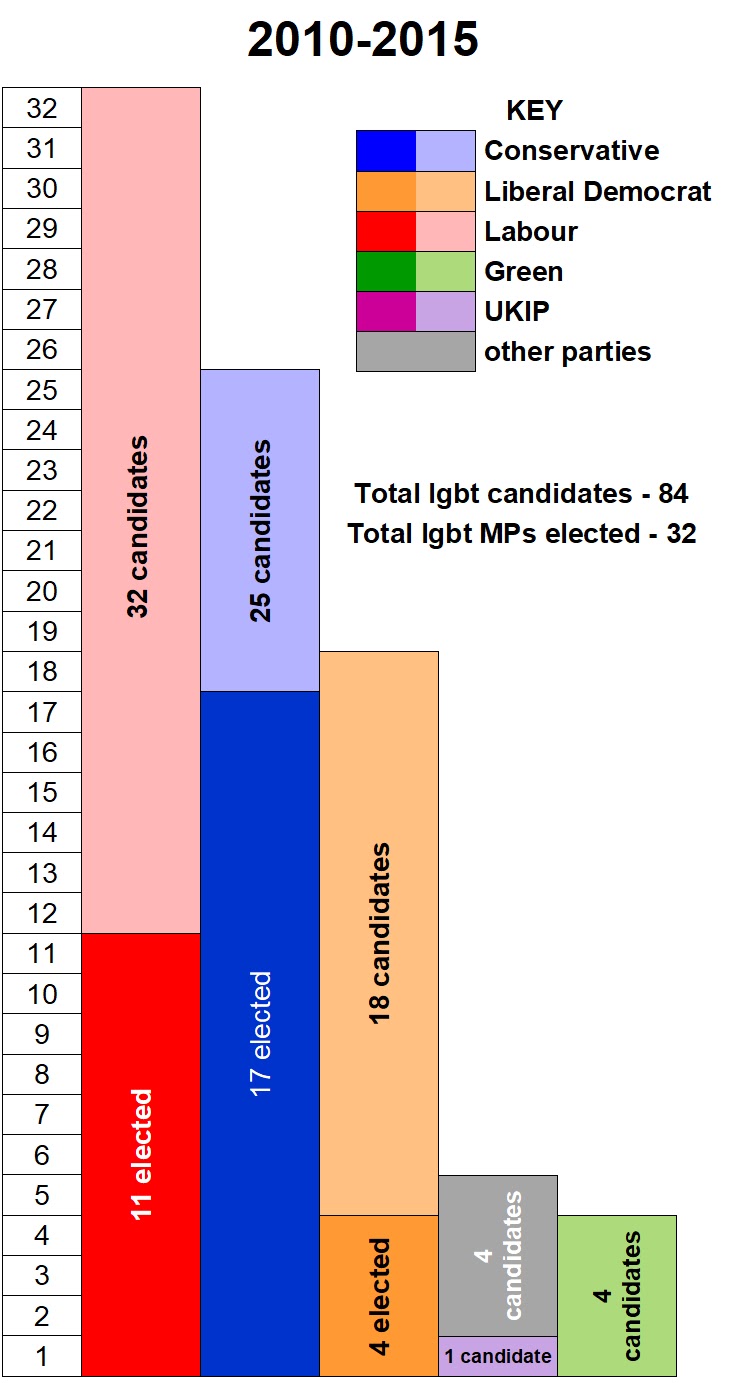
I’ve used the research I’ve done for this blog as the basis for some panels on lgbt history. One panel contains general information on local lgbt history and another is on the origins of some Christmas traditions which I featured last December. The main panel is on lgbt representation in the UK parliament. Since at least 2005 the UK has had the most openly lgbt members, in both the House of Commons and House of Lords, than any other national parliament in the world.

Rather than have a static, flat panel full of eye-numbing statistics I’ve designed a tactile, moving exhibit in the form of a rotating Big Ben clock tower (officially called the Elizabeth Tower).

On each side of the tower is a chart showing the total known lgbt parliamentary candidates and elected MPs there have been in the current parliament and the three preceding ones. The numbers include candidates and MPs who were not out publicly at the time.

Below is a video of that exhibit and how it fits together and works. Below that are reproductions of the charts on each side. The date are those of the current and previous parliament and represent periods from the day of one general election to the eve of the next. The numbers includes MPs and candidates who have subsequently come as members of the lgbt community.
I was pleasantly surprised to discover a while back that there were actually some lgbt history tours around the Houses of Parliament themselves. I don’t think any other national parliament does this. The lgbt tour is called Pride at Parliament. It concentrates on stories and politicians connected to the current building constructed. I hope to go on one of these tours myself on one of my annual trips to London.

If you’re heading to London yourself perhaps you’ll have time to go on a Pride at Parliament tour. The tours are on specific dates so you may not be there at the right time. I’ll leave you today with a link to the tours webpage here.

Wednesday, 5 December 2018

Around the World in Another 80 Gays: Part 34) Burning Desires

Previously on “Another 80 Gays” : 70) Count Francesco Algarotti (1712-1764) was involved in a love triangle with 71) Lady Mary Wortley-Montagu (1689-1762) and 72) John Hervey, Lord Hervey (1696-1743), who was satirised as a Roman emperor’s boy husband called 73) Sporus (c.49-69).

When Alexander Pope satirised 72) John, Lord Hervey, in “An Epistle from Mr Pope to Dr. Arbuthnot” in 1735 he chose to identify him as 73) Sporus very deliberately because of Hervey’s openly effeminate, flamboyant, bisexual “macaroni” behaviour which made him an obvious target. In his turn Lord Hervey wrote insulting comments about Alexander Pope, mocking his physical deformities and his non-aristocratic background.

One of the reasons for the antagonism between the two is that Pope was jealous of Lord Hervey’s friendship with 71) Lady Mary Wortley-Montagu. In one of his letters Pope referred to Hervey and Lady Mary as “Lord Fanny” and “Sappho”.

Lord Hervey’s political career brought him into direct contact with the king and the royal family. Several modern government ministers are still hold of offices in the Royal Household. Lord Hervey was appointed Vice Chamberlain to King George II, a government appointment made by the Prime Minister. Hervey’s job was to report directly to the King on proceedings in the House of Commons every day. The current Vice Chamberlain is Andrew Stevenson, and openly gay Conservative MP, and his responsibilities are much the same. In 1740 Lord Hervey was “upgraded” to Lord Privy Seal, one of the highest offices of state in England, again a political government appointment, as it still is.

So, who was 73) Sporus? We don’t know much. What we do know comes from the last two years of his short life. He is said to have been about 20 years old when he died. Even his name isn’t his real one, but a nickname given to him by the man who married him, 74) Emperor Nero (37-68). Sporus is a name derived from the Greek word for “sowing a seed”, the inference of sex being deliberate.

Sporus may have been a freed slave. Whether Nero was his master isn’t known but Sporus certainly came to the emperor’s attention after the death of his wife Poppea.

Imperial politics was very complicated in Roman times. There was no properly defined laws on succession and many emperors died at the hands of their successors. One tactic was to marry into, or be adopted by, the reigning imperial family. That’s how Nero himself became emperor.

Although descended from several previous emperors himself Nero gained the throne through the machinations of his mother Agrippina, niece of Emperor Claudius. To ensure her son’s succession she married her uncle and, in due course, Nero became his successor.

Nero had several wives – and husbands. First was his step-sister, Claudius’s daughter. After executing her over false adultery charges Nero married his mistress Poppea in 62. In 64, the year of the Great Fire of Rome, Nero married Pythagoras (not the famous Greek mathematician), so now he had a wife and husband (Nero is known to have taken the passive role with Pythagoras). The following year Poppea died. It is usually said that Nero kicked her to death when she was pregnant, but historians now think she died in childbirth. Whatever the reason, Nero was devastated by her death. But with Sporus she could be with him forever.

Nero married Sporus in 65 because of his resemblance to Poppea. To give Sporus an unusually high profile in public life Nero had the boy castrated and demanded all citizens treat him as his empress. He was dressed in the empress’s royal regalia at public events. As for Pythagoras, non-one knows what happened to him. But Nero married yet again. In 66 he married Statilia Messalina, who wisely kept a low profile and outlived both Nero and Sporus.

Sporus seems to have actually loved Nero, even though there was a 12-year age gap. He was one of the few people who remained loyal to the emperor right up to Nero’s death in 68.

The Senate and the army eventually rebelled against Nero and he committed suicide. Sporus, however, was spared and treated as an imperial “wife” by two other Romans vying for the throne. However, when Vitellus became emperor in 69 Sporus was planned as the victim in a gladiatorial show. Thankfully, Sporus chose suicide was a less painful death.
Let’s go back to Nero and the Great Fire of Rome. In an earlier article on Nero I mentioned that he was in Antium when the fire took place. This is one of several locations where ancient writers place Nero at the time. One writer puts him in the Gardens of Maecenas. These were part of a villa on the Esquiline Hill in eastern Rome which came into the possession of the emperors after the death of the villa’s builder, a Roman statesman called 75) Gaius Maecenas (68 BC-8 BC).

Over the centuries Maecenas’s name has become a byword for a generous patron of the arts. He came from a wealthy, influential family and a glittering political career could have been his for the asking. Instead, he refused all invitations to become a Senator and spent his life and wealth in promoting the arts. He also built his villa which included the first heated swimming pool in Rome. It also had places where plays and songs were performed in a sort of theatre. It was from a temporary platform or stage that Nero is said to have watched Rome burn, dressed in his theatrical costume and singing of the destruction of Troy.

Maecenas was primarily a patron of the performing arts rather than the visual arts. He loved all types of performance, and he loved a pantomime performer called 76) Bathyllus (c.60 BC-pre 2 BC).

Next time : From Rome to Britain – the pantomime tradition gets an Oscar nomination.

Monday, 26 November 2018

Around the World in Another 80 Gays: Part 33) An Enlightenment Triangle

Previously on “Another 80 Gays”: 67) Baron Friedrich von Steuben (1730-1794) suggested the throne of the newly independent USA should go to 68) Prince Heinrich von Hohenzollern of Prussia (1726-1802), the brother of 69) King Friedrich II the Great of Prussia (1712-1786), who fell in love with 70) Count Francesco Algarotti (1712-1764).

70) Count Francesco Algarotti was the same age as 69) King Friedrich II of Prussia and they first met when Friedrich was still a prince. They became lovers and when Friedrich became king he showered Algarotti with appointments and honours, including creating him a Prussian Count. Their relationship lasted for two years though they remained close for the rest of their lives.

Before arriving in Prussia Francesco Algarotti travelled all over Europe visiting many Enlightenment figures. One of his acquaintances was Voltaire, the French philosopher who would also later spend a lot of time at the court of King Friedrich. Voltaire gave Algarotti the nickname “The Swan of Padua” because of the way he seemed to glide from one city to the next.

When Algarotti, who had not yet met King Friedrich, arrived in London in 1736 he was a well-known writer, philosopher and scientist. He was in the process of writing a book called (in translation) “Newtonism for Women” on the theories of Sir Isaac newton. It wasn’t long before Algarotti was made a Fellow of the Royal Society.

Algarotti’s arrival at King Friedrich’s San Souci residence got him out of a love triangle in England. The woman involved was one of the most free-thinking intellectual women of her time, 71) Lady Mary Wortley-Montagu (1689-1762). For more information on Lady Mary go to my two articles on her Extraordinary Life.

The third person in this Enlightenment love triangle was 72) John Hervey, 2nd Baron Hervey (1696-1743). It was Voltaire who introduced Francesco Algarotti to Lord Hervey in Paris. Hervey was the son of the 1st Earl of Bristol and was elected a Member of Parliament in 1725. As heir to his father’s earldom he was known as Lord Hervey, one of his father’s junior titles. He wasn’t an actual peer of the realm because he was, basically, only “borrowing” the title until his father died. This is still customary in British peerages.

Lord Hervey was such an important member of the government that the Prime Minister of the day didn’t wait until the Earl of Bristol died before Lord Hervey could enter the House of Lords. So Lord Hervey was “accelerated” to the Lords as Lord Hervey in his own right. His father, the Earl of Bristol, relinquished his title of Lord Hervey to his son, and they sat in the House of Lords together. Lord Hervey, sadly, predeceased his father so never became Earl of Bristol.

Although married with 8 children Lord Hervey was well-known for his camp and effeminate personality. His style of dress was flamboyant, in a style that became known as “macaroni” because it was as fashionable among the aristocracy as was the Italian food they encountered on their Grand Tour of Europe. If you remember the song “Yankee Doodle” and wondered why he put a feather in his cap and called it “macaroni”, that’s why – it was fashionably flamboyant.

Lord Hervey was infatuated with Francesco Algarotti from the moment they met, and it was when Hervey later introduced him to Lady Mary Wortley-Montagu that things started to get “interesting”. Lady Mary was well over 40 years old by then, 20 years older then the two men. Her failed marriage and unhappy family life needed some pleasantness and Algarotti provided it.

The three of them spent a lot of time together in England. Algarotti read his Newton book to them and Lady Mary helped him to improve his English. In September 1736 Algarotti went back to Italy leaving the two English aristocrats heartbroken. They both wrote love letters to him urging him to return. Algarotti, probably conscious of the complications that might arise, gave polite excuses and encouraged them to continue writing.

Lord Hervey was content to bide his time but Lady Mary was truly infatuated. Her letters became more agonising and she made known her intention of visiting Algarotti in Italy. By this time, however, Algarotti was dating a young man from Milan, so you can almost hear the alarm bells going off in his head when he read that letter.

Algarotti visited England briefly in 1737, staying with Lord Hervey for a while before continuing on his graceful travels around Europe. By this time Lady Mary was virtually stalking him and she travelled down to Turin to meet him. This was in 1741, by which time he had met King Friedrich of Prussia and had been created a count. It was obvious to Lady Mary that she couldn’t compete with a king for Algarotti’s affections and gave up trying.

So what became of our Enlightenment love triangle? Lady Mary spent the next 20 years in retirement in Europe before returning home to die in England in 1762. Count Algarotti died two years later in Italy. Lord Hervey predeceased them both in 1743. His final years were clouded by an unhappy marriage, despite having 8 children. He virtually disinherited his wife in his will.

Throughout his short life Lord Hervey attracted much attention for his effeminate appearance and personality. As well as becoming a famous “macaroni” Lady Mary Wortley-Montagu once remarked that there were three genders in England – male, female and hervey. Other slang terms and names were given to him in his lifetime and he was an obvious target for political satire and caricature. Alexander Pope in his satirical “An Epistle From Mr. Pope to Dr. Arbuthnot” made no attempt to hide his contempt for Lord Hervey by portraying him as the castrated youth who was married Emperor Nero, a youth called 73) Sporus (c.51-69).

Next time : We watch Rome burn then go to a pantomime.

Tuesday, 17 July 2018

Around the World in Another 80 Gays : Part 22) Pride Takes to the Skies

Previously :  42) The Dance of The 41 (1901) gave its name to the derogatory term for a gay man in Mexico which was used by 43) Alberto B. Mendoza (b.1971) in the name of his lgbt organisation which annually honours 41 lgbt Hispanics, one of whom was 44 ) Dr. Alicia Gaspar de Alba (b.1958), a writer of a lesbian mystery novel, a genre pioneered by 45) Katherine V. Forrest (b.1939), a former editor of Naiad Press whose books were published in Czech by 46) Markéta Navratilova (1975).

46) Markéta Navratilova (no relation to the more famous Martina, as far as I know) founded LePress in 2007. It was the first lesbian publishing house to be established in the Czech Republic. Markéta had lived in the UK for a couple of years and was impressed by the amount of lesbian literature that was available in mainstream book stores.

Back home in the Czech Republic Markéta’s friends expressed an interest in reading lesbian fiction but none of the publications were available in Czech. This led Markéta to found LePress as a way of expanding the lesbian literature market into eastern Europe. Looking at the back catalogue of Naiad Press which had been sold to Bella Books Markéta selected two romantic novels which she published as the first Czech language lesbian novels in the Czech Republic. From such small beginnings LePress has grown to include other lgbt publications and genres, including children’s books like the famous “And Tango Makes Three”.

Markéta Navratilova is also an activist. She is a member of the organising committee of the 2019 International Gay and Lesbian Association Europe conference to be held in Prague, and of the organising committee of Prague Pride.

Another member of both committees, and the core team manager of the 2019 conference, is 47) Czeslaw Walek (b.1975). His involvement with Prague Pride came about through his career as a lawyer and human rights campaigner. Between 2009 and 2011 he was Deputy Minister of Human Rights and Minorities. In late 2010 Czeslaw was approached by a group of people who wanted to organise the first Prague Pride. They asked him to draw up a constitution for their committee. His position as a Deputy Minister meant that he had established contacts with the government and police and he attended the committee meetings to offer advice.

By January 2011 the committee was looking for a Chair. Czeslaw was persuaded to accept the position. “Let’s try for a month”, he is reported to have said. Seven years later, in July 2018, he’s still Chair of Prague Pride.

Czeslaw’s appointment as Deputy Minister came during an unstable period in Czech politics. Just two months into the job the Czech government collapsed, and two years later the Human Rights Minister resigned and Czeslaw was put in charge of the department.

One of the areas in which Czeslaw is particularly pleased to have made an impact was the increase in the rights and attitudes towards the Roma community. In 2003 he was appointed Director of the Office of the Governmental Council for the Roma Community. It was in collaboration with Roma groups and the Equal Opportunities Party that Czeslaw campaigned as the Green Party candidate in the 2013 Czech parliamentary election.

His appointments were, so far, non-elective, and during his time in office there was only one openly lgbt member of the Czech government, Gustav Slamečka, the non-elected Minister of Transport (2009-10). Czeslaw didn’t win his Prague seat in 2013 and so didn’t earn the honour of being the first openly elected member of the lower house of the Czech parliament.

However, there had already been an openly lgbt member of the upper house, the Senate. He was 48) Václav Fischer (b1954). He was elected as an independent, openly gay, Senator for Prague’s municipal district 1 in 1999 with a massive 71% of the vote. During his three-year term of office he worked on the European Integration Committee. He decided not to seek re-election at the end of the three years.

Part of the reason for his success in the election was due to him being a successful and popular businessman. In 1999 his airline company, Fischer Air, was (after Skoda and Budweiser) the most recognised corporate brand in the Czech Republic. The origin of the company went back to 1980 when Václav, then living in Germany, founded the Fischer Reisen travel agency.

Following the Velvet Revolution and the long-overdue collapse of the Communist Czech dictatorship Václav leapt into the growing tourism markets. This was the basis of his success. By 1995 his business had become so successful that he was able to sell the original German part of Fischer Reisen to Lufthansa, and with the money bought a fleet of planes and set up Fischer Air.
Despite this success Václav Fischer and his company were declared bankrupt in 2003. The Czech economy was not stable enough to sustain the demand of his services. In 2005 Václav returned to Germany and set up other travel/tourism ventures and currently runs Aircraftleasing Meier and Fischer.

Vaclac Fischer is one of very few lgbt businessmen to run an airline. Another, who also has links to Lufthansa, is 49) Sir Michael Bishop, Baron Glendonbrook (b.1942).

Next time : We fly down to Rio with Lufthansa.