Saturday, 16 April 2022

Extraordinary Life: The Japanese da Vinci - Part 2


After a really horrible first quarter of the year in which I have been battling illness, I really must apologise and catch up on my planned schedule. Last summer I wrote about the samurai who has been called the Japanese Leonardo da Vinci, Hiraga Gennai (1728-1870). The parallels between them aren’t exact but the sheer scope of Hiraga’s activity is more than enough to justify the comparison.

In that first article we left Hiraga relinquishing his feudal duties and abandoning any responsibilities to any feudal lord. He had the independence to pursue his own interests. A chronological survey of his life would see us jumping from one discipline to another. Individual surveys of each will reveal a better picture of Hiraga’s genius.

Let’s begin with the main focus of Part 1, which was Hiraga’s use of marketing. Product promotion isn’t something that was created in recent decades. The spread of the printing press across the globe from the 14th century helped to spread advertising and promotion more widely than any previous method. In Japan the development of printing during the first part of the Edo Period (1603-1868) saw a big increase in marketing, especially after paper prices began to drop.

The three main methods of advertising were product sponsorship of events, distribution of printed leaflets, and promotion of products during seasonal festivals. In fact, this is very much what we still see today. Hiraga used all of these methods. The third method was highlighted in Part 1 with his suggestion of promoting eels during the Midsummer Day of the Ox. This influenced others to sell their products and services in similar ways.

Among the other products Hiraga had a major hand in promoting was tooth powder, but he was also instrumental in the development of regional expositions of local products. He arranged several expositions from 1757, sending out invitations to potential exhibitors, writing and printing catalogues and promotional material and publicising them across a wide area. These expos increased national awareness in natural sciences such as pharmacology, agriculture and mining.

Hiraga’s interest in mining led to the setting up of several mining projects. Even though these eventually failed they did lead to the creation of the Arakawa River which greatly helped in the shipping of coal. One alarming mining project was finding a way to turn asbestos deposits into fire-resistant cloth.

Most of Hiraga’s accomplishments were influenced by his contact with Dutch merchants. The Dutch and Chinese were the only foreign merchants allowed into Japan and from them Hiraga learnt of the arts and sciences not known in Japan. Hiraga’s insatiable quest for knowledge drew him to the Dutch like a magnet. This made him a pioneer in Dutch studies in Japan, which is known as Rangaku.

Everything Hiraga learnt about European advances in science and technology came through observation and experimentation rather than formal tutoring. One of the devices he came across during his contact with Dutch merchants was a broken static electric generator. By disassembling it and working out how each part worked Hiraga managed to get the generator working again. It took him several years and the result caused a sensation. He gave public demonstrations of it working and gave electrotherapy to patients. Copies were made and other people began to use them in market places.

Another result of Hiraga’s contact with the Dutch was influenced by his knowledge of mineralogy and chemistry. As I mentioned above he developed mining techniques and he located a particularly good source of clay for producing high quality pottery. He persuaded the government to help him set up kilns and workshops, aimed at reducing the reliance on obtaining pottery from China or Holland. With influences from Dutch pottery Hiraga developed a new style that combined both Dutch and Japanese elements. This style became very popular and is now named after him – Gennai ware.

Hiraga’s knowledge of geology also led him to investigate the use of minerals in the production of paints and dyes. You’ll not be surprised to learn that Hiraga was an accomplished painter. Unfortunately, very little of his work survives, and there’s only one of his oil paintings known to exist today.

If you’ve read Part 1 of this Extraordinary Life you’ll probably be intrigued by a particular comment I made and are eager to know more. It was about Hiraga writing a book about farting whose title translates into English as “The Theory of Farting”. The title makes it sound like the book is a serious study of the subject, but is actually a satirical novel (Hiraga loved writing satire, which was a popular genre in his lifetime). The “Theory” is more of a discussion than a novel, not unlike ancient Greek philosophical works. The author describes his encounter with a street performer who could fart tunes and animal noises. A fellow spectator is appalled at the performance but the author goes into a speech on how farting is superior to any other art form. The performer is self taught, not a product of a school where he was taught to copy previous artists using established instruments and techniques. Hiraga is taking a dig at the artistic establishment, even though he was part of it himself. It reminds me of a performer called Methane Man who had a similar farting act and appeared on “Britain’s Got Talent”.

Hiraga was not just a satirist. He could turn his hand to other literary forms. His pioneering use of marketing was utilised in the catalogues he wrote for his many trade expositions; he write scientific books; and he write poetry. Hiraga’s homosexuality played a role in other works, such as a guide book on male prostitutes and passages on gay sex in his novels. One of his novels I am really interested to read is “Furyu shidoken”, Hiraga’s version of “Gulliver’s Travel”. The stories are not exact in content because it’s unlikely that Hiraga had actually seen a copy of “Gulliver’s Travels”. He may have heard snippets about the novel from his Dutch contacts and used these as inspiration for his own novel.

With the extraordinary variety of disciplines Hiraga Gennai took up it is highly appropriate to compare him with Leonado da Vinci. However, unlike da Vinci, Hiraga’s life ended on a down note. Several accounts of his final year vary in the detail but agree on the final outcome. In 1779 Hiraga was arrested for murder (of a carpenter or one of his disciples). Hiraga was imprisoned and died in jail at the end of the year.

Many scholarly works on Hiraga Gennai repeat the word “extraordinary” when describing his works, deeds and legacy. Like so much of east Asian history, comparatively very little is known in the west. While Hiraga may be unknown to the majority outside Japan in his native country, even in modern anime, his name is well known and familiar.

Friday, 25 February 2022

Beijing 2022 - Another Record Breaking Olympics

As I mentioned last time I have been unwell in recent weeks. As a result I wasn’t able to follow and enjoy the Beijing Olympics as much as I had hoped. Therefore, there may be some information which I may miss today.

As promised, the updated complete Winter Olympian list is given at the end, but we’ll start with the Beijing results. This Outsports article lists all the lgbt medal winners. Team LGBT broke several records. It was the biggest ever team at the Winter Olympics and follows the trend shown in the summer games. However, in terms of total number of athletes who won medals Beijing ranks third with 15 (10 gold, 2 silver, 3 bronze), behind Turin 2006 (7 gold, 4 silver, 7 bronze) and Sochi 2014 (6 gold, 10 silver, 1 bronze). These numbers, however, include medals won by athletes who were not openly lgbt at the time. But Beijing did produce more lgbt Winter Olympic champions.

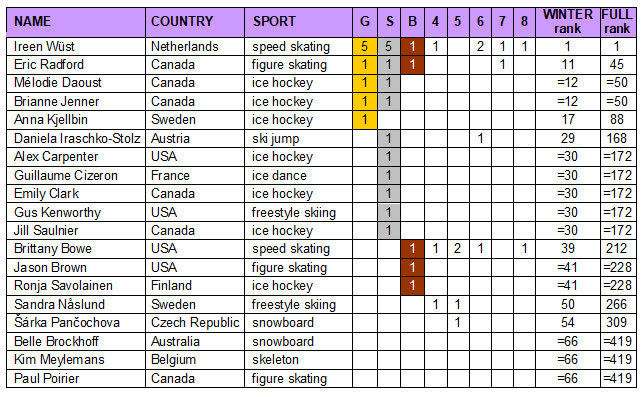
The table below gives the full Beijing results incorporated into the all-time rankings and top 8 finishers. The light blue sections indicate Olympians who won at least one medal and/or top 8 finish. The pale green N boxes indicate the positions of the Olympic debutantes. The = sign indicates that there may be Olympians from previous games who share the same results and ranking. Bear in mind that an Olympian who wins a medal may move down the ranks if other athletes win a higher, or more than one, medal.

Dutch speed skater Ireen Wüst consolidated her place as the most successful lgbt Olympian, and the most successful Dutch Olympian of all time. Ireen also became the first ever Olympian to win an individual gold medal in 5 successive Winter games. Her Beijing gold and bronze medals brings her total medal tally to 13, putting her in second place in the all-time most medalled Winter Olympian (she is 4th in terms of the number of gold medals, with the top 3 each having 8). With such a commanding lead it is very unlikely that she will be surpassed in the lgbt rankings in the foreseeable future (up to 2034), not unless another Michael Phelps or Ian Thorpe emerges to win multiple medals in one games. I don’t expect anyone will overtake Ireen Wüst in my lifetime.

On 4th February I mentioned that Angela Ruggiero was the first openly lgbt member of the International Olympic Committee and its Athlete’s Commission. Beijing could have seen the second, as Ireen Wüst was one of the candidates who put themselves forward for election to the two vacant seats. Unfortunately, she wasn’t elected.

For the first time there were openly lgbt flag bearers at the both the opening and closing ceremony. There have been other lgbt Olympians who had carried their national flags in previous games, but none of them were openly lgbt at the time (though I’m still trying to verify if Chris Witty was out when she carried the Stars and Stripes in Turin 2006). There has also been two flag bearers in one ceremony, but Beijing was the first time there has been one at each ceremony – Brittany Bowe at the opening, and Bruce Mouat at the closing.

The figure skating attracted the most controversy because of a failed drugs test. However, there was enough other notable facts that emerged from that competition. First of all, there was the largest contingent of openly lgbt skaters than ever before, a total of 7. This included the first known non-binary skater, Timothy LeDuc (though we don’t know for sure how all the previous lgbt skaters identified themselves). As has happened in previous sporting events, the lgbt media took it upon itself to police the words of commentators over the use of personal pronouns. In a democratic world only Timothy LeDuc has the right to decide what words were disrespectful.

Beijing provided us with the first lgbt Olympic champion in ice dance, gay Frenchman Guillaume Cizeron and his dance partner Gabriella Papadakis, In a competition full of queer elements Papadakis and Cizeron’s rhythm dance was heavily influenced by waacking, a form of street dance that originated in the Los Angeles gay and disco clubs of the 1970s. The queer theme was also present in the rhythm dance of the Canadian pairs skaters Piper Gilles and the openly gay Paul Poirier with their vivid orange “Rocketman” costumes and Elton John soundtrack.

Before we move on to other sports let’s return to the Russian skater at the centre of the drug controversy, 15-year old Kamila Valieva. This time we acknowledge concerns around her young age and the effect of competing at an Olympics. She’s not the only teenager to compete at the Olympics. Way back in 2016 I wrote about other teenage Olympians (which needs to be updated in the future). What doesn’t need updating is the age of the youngest ever lgbt Olympian (although he was never out publicly in his lifetime) the Slovak figure skater Ondrej Nepela who competed at the 1964 Winter Olympics a week after his 13th birthday.

Teenagers’ bodies are not fully developed and they are at a disadvantage when competing against older athletes, no matter how good they are. They are more suited to the Youth Olympics, where there is a more level field of competition. That is why the Youth Olympics were created.

Elsewhere in Beijing we saw another record broken in the women’s ice hockey tournament. The Canadian team had 7 openly lgbt players, the largest in any team sport at the Winter Olympics. By winning the gold medal they became the largest lgbt group in a team event to become Olympic champions. They also broke the record of scoring the most goals in an Olympic ice hockey tournament, and that was before they played their semi-final.

That’s all the information I was able to gather during my illness, but I hope it still shows you just how prominent lgbt athletes continue to be at the Olympics. So, to bring this year’s Olympic coverage to a close here is the updated complete list of lgbt Winter Olympians.

https://drive.google.com/file/d/1MSdscNsNIXJU50YkPfaD9b0G2iT_yuv1/view?usp=sharing

Friday, 4 February 2022

Two Winter Firsts

The Winter Olympics return today surrounded by covid restrictions and diplomatic boycotts. But, as with Tokyo 2020, we should make the most of it and enjoy the spectacle of an international multi-sport event. The list o f out athletes competing in Beijing can be found here.

Last week we looked at the earliest lgbt Olympians and medallists and left us all wondering who was first. However you look at it, the first lgbt Olympic medallists were George Mallory and John Morris in 1924 for their 1922 Everest expedition. Figure skater Geoffrey Hall-Say and real-tennis player Eustace Miles may have been earlier (both 1908) if their sexuality can definitively pinned down. At the moment the lawn tennis player Leif Rovsing is the person we can prove was the first lgbt Olympian (1912).

In the previous lists that I have published the first known lgbt Olympic competitor at the official winter games (i.e. after 1924) was figure skater Ronnie Robertson at the 1958 Olympics in Cortina d’Ampezzo. He is the first lgbt Winter Olympian to win a medal (bronze) during competition. Research I was able to concentrate on during the covid lockdown in 2020 revealed that there was an lgbt figure skater who competed at the previous Winter Olympics in Oslo in 1952.

The newly identified first Winter Olympic competitor is Peter Firstbrook (1933-1985). Peter came from that hotbed of modern lgbt skating, Toronto, Canada. A lot of Olympic skaters, past and present, have trained or coached in Toronto at some point. Both Peter’s father and grandfather were engineers. His grandfather also invented a table saw. However, his mother’s brother was Hubert Sprott, a Canadian national champion figure skater in the neglected discipline for fours – two pairs of skaters performing together.

A more detailed look at Peter Firstbrook’s life and career can be found here, but I’ll go over it briefly.

Peter entered his first national championship at the age of 14, competing in the junior pairs competition. He came third. From then on his rise in the national rankings in singles, pairs and fours rocketed. He represented Canada at the Winter Olympics in Oslo at the age of 18, finishing 5th. Gold went to the legendary Dick Button, who performed the first ever triple loop in competition.

Peter was being tipped as a future world and Olympic champion, but he decided to turn professional in 1953. He toured with several ice shows for five years before suffering an injury which stopped him from performing fully. So, he turned to training. Peter retired from skating and coaching to join an artistic commune in Mexico. He died there are the young age of 51 of pneumonia.

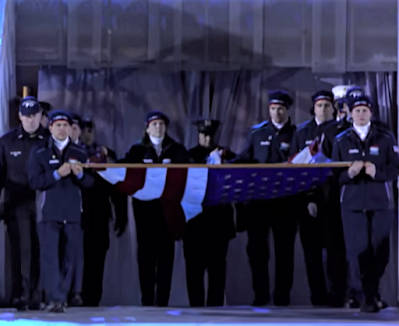
The first and only known lgbt member of the International Olympic Committee (IOC) was Angela Ruggiero (b.1980). Angela was an American ice hockey player who won one gold, two silvers and one bronze over four successive Olympics. Her first were in Nagano in 1998 while she was still a student and was the youngest person on her team. They won the gold medal in what was the first ever Olympic women’s ice hockey tournament. It is testament to Angela’s value to the team that at the 2002 Salt Lake City opening ceremony Team USA chose her as one of the eight American Olympians to act as honour guard to the tattered Stars and Stripes that was recovered from the ruins of the World Trade Centre after the terrorist attacks of the previous September (as seen below).

Angela’s final Olympic appearance as a competitor was in Vancouver 2010. During those games she was elected onto the IOC’s Athlete’s Commission. She appeared at the closing ceremony with the other newly elected member, UK’s Adam Pengelly, to present gifts to some of the games’ volunteers.

Members of the Athlete’s Commission are elected for an eight year term and are full members of the IOC during that time. Their duties include raising awareness of issues that effect athletes and advise on various related issues. Angela Ruggiero took a leading role in the commission and was elected as it’s Vice-Chair in 2014, and it’s Chair in the last four years of her term. During her final two years she was a member of the IOC’s Executive Board.

As well as being a member of the Athlete’s Commission Angela was a member of many others. Among them were the Co-ordination Commissions of the Lillehammer Youth Winter Olympics (2012-16) and the PyeongChang Winter Olympics (2012-18), and that of the current Beijing games. She has been a member of several Olympic Bid committees, and since leaving the Athlete’s Commission has become a member of the IOC’s Digital and Technology, Ethics, and Nomination commissions.

As a member of the IOC Angela was called upon to present medals at various ceremonies (London 2012 and Rio 2016), and has run in the torch relay three times (London 2012, Sochi 2014, PyeongChang 2018).

There’s no space to give justice to Angela’s full involvement in the Olympic movement and sports administration outside the Olympics. Her influence extends beyond 2022. In 2016 she was appointed as Chief Strategy Officer of the Los Angeles 2024 bid. This meant that as an IOC member she was ineligible to vote on who would by awarded the 2024 Olympics. In the end, this didn’t matter. As we know, there was only one other bid submitted, Paris, and no-one was showing any interest in bidding for 2028. So, between them, the LA and Paris Bid committees and the IOC decided to give the 2024 Olympics to Paris, and the 2028 Olympics to LA. Angela remained as Chief Strategy Officer until stepping down in 2020.

I had hoped to produce the full Winter Olympian list today. Unfortunately, I’ve been ill in the last few days and have been unable to complete it. It will produce it after the games have finished, when it will be have been fully updated with the Beijing results.

The other table that I can show you today is the current medal rankings of the Olympians who are returning to Beijing 2022. I’ll briefly go over the format. Athletes are list in order of rank. All placings up to eighth position are counted (these usually receive an Olympic finalist diploma). The WINTER rank gives that athlete’s position in the all-time Winter Olympic rankings only (any medals of placing achieved during a Summer Olympics are not counted). The FULL rank gives the athlete’s position when all summer and winter Olympics, and all lgbt Olympians are included. Bear in mind that there have been a substantially lower number of Winter Olympians (114, including Beijing 2022) than Summer Olympians (492 to date). Also bear in mind that this list does not include athletes making their debut in Beijing.


Tuesday, 25 January 2022

Olympic Winter in Summer

The first covid lockdown gave me the chance to do a lot of new Olympic research. Last year I presented some of it for the Tokyo games, but there was so much more new information that I'm going to split the rest of it into two. Part one is given here, and the rest on February 4th. 

As with other recent Olympic Games I have again been collaborating with Outsports to provide the most complete list of lgbt athletes who will be competing in Beijing in a couple of weeks time. I’ll produce the full Winter Olympian list with the Beijing names on February 4th. To see the Beijing list as its updated, go to the Outsports website here.

Later I’ll look at the possibility that the first lgbt Olympians may have competed in 1908, predating the previously named athlete by twelve years. First I want to look at a centenary in lgbt Olympism – the first gold medallists. However, the medals weren’t actually awarded until two years later at the first Winter Olympics in Chamonix, France, in 1924. At the 1894 Olympic Congress which founded the Olympic movement an Alpinism Prize was created. This was to be awarded for achievements in mountaineering in non-Olympic years and was first awarded at the Chamonix games.

The Alpinism Prize, consisting of gold medals, were awarded to the thirteen British and Australian members of the 1922 Everest Expedition, the first formed specifically with the aim of reaching the summit. The medals were presented at the Chamonix closing ceremony and were accepted by the deputy leader of the expedition, Lt.-Col. Edward Strutt. The Sherpas and guides were also awarded medals some years later. Even though the medals are often regarded as Olympic gold medals, the IOC doesn’t count them in their medal tables, but in my opinion, and in the opinion of others, their receipt of an Olympic gold medal qualifies their status as Olympic medallists.

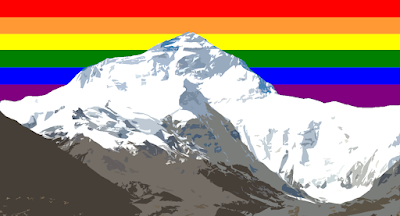
Everest and the Rainbow Pride flag.

The most famous member of the 1922 expedition is George Mallory (1886-1924). He never got to see his medal. At the time they were being presented he was on his way back to the Himalayas on the Everest expedition on which he was to die. I wrote a little bit about Mallory several years ago here.

Even though there’s still debate about Mallory’s sexuality, there’s none about another member of the 1922 expedition, Maj. John Morris (1895-1980). He wrote about his sexuality in his memoirs. Morris’s role in the expedition was as transportation officer and interpreter, ensuring that all supplies and equipment were ordered and transported to the correct locations.

Morris joined another Everest expedition in 1936, once again as transportation officer and interpreter. His assistant was Tensing Norgay, the sherpa who successfully reached the summit of Everest in 1953 with Edmund Hillary.

After leaving the army in 1937 John Morris became a lecturer at several Japanese universities, but after Japan entered World War II Morris was repatriated to the UK. Almost immediately afterwards he joined the BBC Far Eastern Service working in the same office as the vehemently homophobic author George Orwell. After Orwell’s death Morris wrote of the constant homophobic abuse he received from him. From 1952 to 1957 Morris was appointed Controller of the BBC’s Third programme (now called Radio 3) the corporation’s channel dedicated to classical music.

At the moment, George Mallory and John Morris are the first known lgbt Olympians. But can we identify an lgbt Olympian before them who actually competed at the games? Research has come up with two possible names.

Before them I’II mention E. F. Benson (1867-1940). He is best known as a novelist and member of a remarkable queer family which I looked at briefly here. Benson was also an accomplished figure skater, competing for Great Britain in international competitions. In 1900 he became a member of the National Skating Association. Even though Chamonix 1924 is the first official Winter Olympics, several winter sports were included in previous summer games. In London in 1908 figure skating made its Olympic debut. Benson joined the organising committee with responsibility for figure skating. He also wrote several books on the subject.

Even though he wasn’t an athlete, E. F. Benson is the first known lgbt member of an organising committee (though not of a national Olympic committee – see below). His sexuality is well recorded, though two other men from London 1908 show how it is often difficult to ascertain a person’s sexuality from that period in time. Let me say from the start that we cannot claim that either of these men were gay or bisexual, only that there isn’t enough evidence to know beyond doubt.

The first was a close friend of Benson, Eustace Miles (1868-1948). He won a silver medal in jeu de paume (another name for real tennis, as opposed to lawn tennis) at the 1908 Olympics. He was the amateur world champion 8 times. He and Benson studied at Marlborough College where their friendship began. It is known that Benson had a huge crush on Eustace Miles, and some of Benson’s biographers suggest a physical relationship between them. Benson’s diaries and letters are too discreet to know for sure, and no-one has yet written a full biography of Miles. In 1906 Eustace Miles married Dorothy Killick. They had no children.

Miles and Benson wrote several books together on healthy diets, sport and exercise. Miles advocated what would today be considered fashionable but what was regarded as “fad diets” in his lifetime. These revolved around vegetarianism and no alcohol. He opened what was probably the first vegetarian restaurants and health food shops in Britain. Even though these were very successful his ideas soon went out of fashion and he went bankrupt.

What can we say about Eustace Miles’ sexuality? Here’s a quotation from “The Life of E. F. Benson” by Brian Masters (Chatto and Windus, 1991): “His [Benson’s] abiding friendship, however, one that survived all the trivial upheavals of romance, was with Eustace Miles… The attachment of Fred [E. F. Benson] and Eustace Miles bears all the marks of a mature and sensible alliance, based on more than physical beauty and the flutterings of a malleable heart.”

The second name to consider is Geoffrey Hall-Say (1964-1940). He won a bronze medal in the figure skating competition organised by E. F. Benson. At the age of 44 he is still the oldest person to win an individual Winter Olympic medal. Very little is known of his private life, though his sporting influence went beyond skating. He was a keen snooker player, a council member of the Billiards Control Club, a boxing administrator and a yacht racer. Hall-Say never married and lived for a time with other bachelors, and in the 1930s he moved to Brighton, a town known for its gay, drag subculture at the time.

Geoffrey Hall-Say’s private life is similar to that of many gay men of his time who lived in the closet. Much more research is needed to determine if he was also one. An irony is that his childhood home of Oakley Court in Berkshire will be familiar to many as Dr. Frank N. Furter’s castle in “The Rocky Horror Picture Show”.

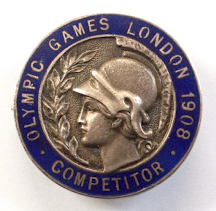
The London 1908 Olympic competitor badge, which both Eustace Miles and Geoffrey Hall-Say would have worn.

Perhaps we’ll never discover the identity of the first lgbt Olympian. Too much secrecy surrounds the lives of people in those days. We can only speculate.

Even more recent research has uncovered the presence of an lgbt individual at the very first modern Olympics in 1896. He wasn’t an athlete, but the Chairman, later the President, of the German Empire National Olympic Committee. His name is Prince Aribert von Anhalt (1864-1933). He is the first known lgbt member of a national Olympic committee.

The prince’s homosexuality was hinted at in his lifetime, but later and modern historians claim that his marriage to Queen Victoria’s grand-daughter ended after he was found in bed with another man. I’ll write more about Prince Aribert in a future “Game of Gay Thrones” article.

Whatever contribution they have made to the Olympic Games, whether as an athlete, coach, committee member or judge, we can now say that there has been an lgbt presence at every Summer Olympic Games – except 1904.

On February 4th I’ll publish the full update list of lgbt Winter Olympians with some facts and figures. Among them will be the newly identified first lgbt Winter Olympic competitor (as opposed to mountaineers or the Summer Olympians discussed above) and the Winter Olympian who has had the biggest influence on the games.