Showing posts with label birthdays. Show all posts

Sunday, 8 December 2024

Advent 2: Christmas Werewolves Among Us

Werewolves at Christmas? What have werewolves got to do with Christmas?

Well, forget most of what you think you know, because the werewolf of popular culture has been influenced more by modern film than traditional folklore. Werewolves are part of almost every culture in Europe, and the majority of these tell of how werewolves are only created during the Christmas season.

Perhaps the most widespread belief our European ancestors had was that anyone born on Christmas night, between the hours of sunset on Christmas Eve to dawn on Christmas Day, was automatically inclined to become a werewolf when they reached adulthood. There are variations of this idea, including substituting conception on Christmas night instead of birth, making anyone born on the following September 24th likely to be a future werewolf. While it was known who was born or conceived on those dates there is no evidence that their communities tried to kill them before they reached adulthood in order to prevent them from becoming werewolves.

In medieval Normandy, France, it was believed that anyone who was excommunicated from the Catholic Church during Advent would turn into a werewolf every night until received back into the church by a priest. While in Germany it was believed that anyone born on any of the 12 Days of Christmas would become a werewolf.

The date on which people turned into werewolves also differs from place to place. In Poland they would only transform on Midsummers’ Day or on their birthday, Christmas Day. In Italy they transformed on December 13th, which was the date of the winter solstice before the current calendar was introduced in 1582. There is little indication that the moon had anything to do with any transformation, except from a small region of southern France, and transformation was not restricted to a wolf, it can be any were-animal. The moon effect was introduced by Universal Studios for the 1943 film “Frankenstein Meets the Wolf Man”.

Belief in a lot of countries say that all werewolves would transform every night after their first transformation until they were either blessed by a priest while in were-form, repented of their sins in church during the day while in human form, or were killed or died.

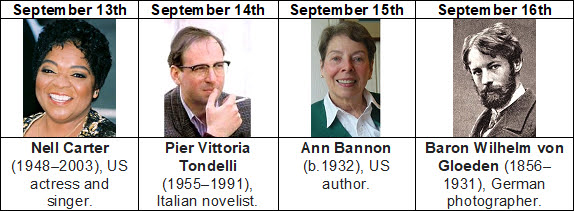
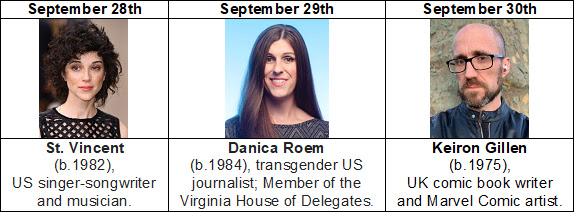
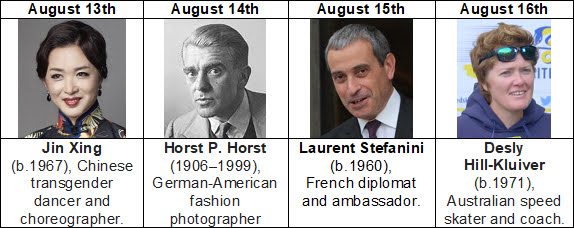
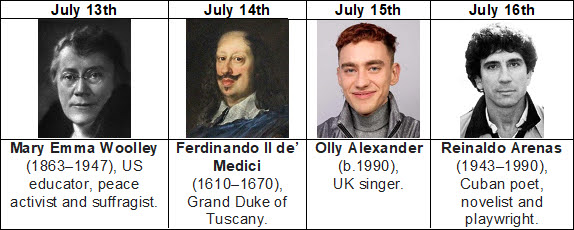
So, were you born or conceived on any of those dates mentioned? Are you a closeted werewolf and you didn’t know? You’re in good company, because there are many in the lgbt+ community who could be, according to traditional European belief, and here’s a selection of some of them. I haven’t included all the birth dates in Advent or 12 Days of Christmas as mentioned above because there are too many names to include if I do.

Born on December 13th

Anne-Marie Alonzo (1951-2005) – Canadian playwright, novelist, poet and publisher.

Linda Bellos (b. 1950) – British political activist; Leader of Lambeth Council, 1986-8.

Anthony Callea (b. 1982) – Australian singer and actor ("Australian Idol" 2004 runner-up).

Rev. Mari Castellanos (b. 1947) – President, Dignity US Miami chapter.

Jackie Clune (b. 1965) – British singer and actor; former Karen Carpenter tribute singer.

Michelle Duff (b. 1939) – Canadian transgender Grand Prix motorbike racer.

Peter Gajdics (b. 1964) – Canadian writer on surviving conversion therapy.

Anton Hysén (b. 1990) – Swedish footballer (soccer).

Richard Isay (1934-2012) – American writer, broadcaster and psychiatrist.

Hon. Desmond Parsons (1910-1937) – British linguist and aesthete.

Jim Quixley (1931-1991) – Australian children's author; librarian at York University, Toronto.

José Sarria (1923-2013) – American drag performer; 1st known out lgbt person to run for US public office.

Allen Schindler (1969-1992) – Radioman Petty Officer, US Navy (murdered).

Most Rev. Mark Shirilau (1955-2014) – American founding Archbishop of the Ecumenical Catholic Church.

Laís Souza (b. 1988) – Brazilian Olympic gymnast.

Theodora Versteegh (1888-1970) – Dutch classical singer.

Tom Wakefield (1935-1996) – British novelist and short story writer.

Born on December 24th/25th – I’ve included both of these dates because it is difficult to determine who was born between sunset on Christmas Eve and dawn on Christmas Day, the night during which werewolves were born.

Born on December 24th

Bethany Black (b. 1978) – British transgender comedian and actor.

Mauro Bordovsky (b. 1956) - founder member of West Hollywood Aquatics.

Eliza Cook (1818-1889) – British author and Chartist poet.

Dean Corll (1939-1973) – US serial killer (the Houston Mass Murders).

Lee Daniels (b. 1959) – Oscar-winning American film producer ("Monsters Ball").

Maik de Boer (b. 1960) – Dutch fashion stylist and social commentator.

Nathan Fain (1942-1987) – American journalist and co-founder of Gay Men's Health Crisis.

Deborah Glick (b. 1950) – member of the New York State Assembly since 1991.

Adam Haslett (b. 1970) – American fiction writer; Pulitzer Prize finalist.

Brenda Howard (1946-2005) – pioneering American bisexual activist.

Howard Hughes (1905-1976) – American tycoon, aviator and philanthropist.

Robert Joffrey (1930-1988) – American dancer and choreographer.

Kevin Killian (1952-2019) – American writer and poet.

Dominic Koll (b. 1984) – Austrian Olympic swimmer.

Adam Lippes (b. 1972) – American fashion designer.

Ricky Martin (b. 1971) – Puerto Rican pop singer.

Joep Mesman (b. 1981) – Mr. Gay Netherlands 2006.

Nestor Perlongher   (1949-1992) - Argentinian writer and anthropology professor.

Jim Roth (b. 1968) – Chief Deputy and Attorney, Oklahoma County Commission.

Bob Smith (1958-2018) – American comedian and writer.

Ans van Dijk (1905-1948) – Dutch Nazi collaborator (executed).

Born on December 25th

Ramona Bachmann (b. 1990) – Swiss footballer (Women's World Cup 2015).

MIanne Bagger (b. 1966) – Danish transgender golfer.

Brad Benton (b. 1974) – American gay porn actor (and “Dante’s Cove” gay soap opera)

Albert Cashier (1843-1951) – Irish cross-dressing Union soldier in the American Civil War.

Staceyann Chin (b. 1972) – Jamaican spoken-word poet and activist.

Kenny Everett (1944-1995) – British DJ and entertainer.

Noël Greig (1944-2000) – British actor, director and playwright of the early gay theatre movement.

Christine Johnson (b. 1968) – member of Utah House of Representatives 2007-10.

Christine Kaufmann (b. 1951) – Montana State Senator 2007-17.

Ismael Merchant (1936-2005) – Anglo-Indian film producer.

Jessica Origliasso (b. 1984) – Australian singer-songwriter and actor.

Conny Perrin (b. 1990) – Swiss tennis player.

Alexander Scriabin (1871-1915) – Russian classical composer.

Noel Tovey (b. 1934) – Australian dancer, choreographer and actor.

Tonie Walsh (b. 1960) – founder of Irish Queer Archive.

Joey Yale (1949-1986) – American gay porn actor.

Born on January 6th

Jeff Bennett (b. 1965) – American activist; co-founder of Gay.com.

Herman Emmink (1927-2013) – Dutch singer, radio and TV broadcaster.

Juan Goytisolo (1931-2017) – Spanish novelist, poet and essayist.

Bjørn Lomborg (b. 1965) – Danish environmental economist.

Kate McKinnon (b. 1984) – American comedian, impressionist and actor.

Hon. Nancy Ruth (b. 1942) – Ontario Senator, Canada, 2005-17.

Danny Pintauro, (b. 1976) – American actor ("Who's the Boss" child star).

Charlotte Endymion Porter (1857-1942) – American editor and writer.

Walter Sedlemayr (1926-1990) – German actor (murdered).

Hugues Sinclair de Rochemont (1901-1942) – Dutch journalist; member of the Nazi Party.

Hugh Skinner (b. 1985) – British actor (plays Prince William in the UK series “The Windsors”).

Gábor Szeley (b. 1968) – Secretary of State 2006-9; 1st open lgbt member of Hungarian government.

Peter Whittle (b. 1961) – British parliamentary candidate 2015 and 2017.

John Wieners (1934-2002) – American Beat poet.

Born on September 24th

Rt. Hon. Sir Conor Burns (b. 1972) – British MP 2010-24; Minister of State 2019-22.

Luke Clippinger (b. 1972) – member of Maryland House of Delegates since 2011.

Louis Edmonds (1923-2001) – American actor (237 episodes of “All My Children”).

Michelle Ferris (b. 1976) – Australian Olympic cyclist.

Richard Groenendijk (b. 1972) – Dutch comedian, actor and writer.

Simon Hobart (1964-2005) – British club founder (Popstarz), and DJ (Heaven).

Casey Johnson (1979-2010) – American Johnson & Johnson pharmaceutical heiress.

Patrick Kelly (1954-1990) – American fashion designer.

Mark Leno (b. 1951) – California State Senator 2008-16.

John Logan (b. 1961) – American playwright and screenwriter (“Gladiator”, “Skyfall”).

Paul Mills (1924-2004) – American Director of Santa Barbara Museum of Art, 1970-82.

Ross Mathews (b. 1979) – American tv host and personality.

Yves Navarre (1940-1994) – French novelist.

Jack Pierson (b. 1960) – American photographer and artist.

Amy Scholder (b. 1963) – American writer and literary editor.

Horace Walpole (1717-1797) – 4th Earl of Orford; British writer and gothic novel pioneer.

Next Sunday I hope I’ll give what I had originally planned for today, and explain the links between an early American gay rights organisation, British pantomime dames, and Pueblo dances in New Mexico.

Wednesday, 15 November 2023

Look Who's 60: Part 1

The world’s longest running science fiction television series is 60 year old next week. “Doctor Who” made its debut on 23rd November 1963 on BBC1. Americans may recognise the date as the day after President Kennedy was assassinated.

For most of those 60 years, particularly since the 1970s, “Doctor Who” has had a massive queer following. It has also had a massive queer presence in its production team, going all the way back to the very first episode. In this, and 2 more articles to follow, I’ll be listing 60 of the lgbt+ contributors to the series and it’s expanded “Whoniverse”.

The three lists that appear over the next week will cover the entire 60 years history of the series. I’ll select significant contributors in chronological order. It won’t be a complete chronology because some years will be left out to make way for multiple individuals who have made a significant contribution or connection in one year. You’ll see what I mean when you read the lists.

Each list will contain 20 names. Many individuals have come back to work on “Doctor Who” more than once. Generally, I will list them according to their first involvement. There may be a lot of “Doctor Who” references that you many not understand. For this I apologise in advance. I’ve tried to keep most references as non-specific as possible.

You may become aware of the scarcity of female names in the first lists. This a reflection on British broadcasting in the mid-20th century. Most people involved in broadcasting were male. It is also a case of not having enough information available on the sexuality of female contributors, even actors, in those early years. 

1) Waris Hussein (b.1938) – Director. Indian-born Hussein directed the very first episodes, “An Unearthly Child”, and the 3 episodes that completed the first story, known today as “The Tribe of Gum” (episodes had individual titles in those days and weren’t replaced with overall story titles until 1966). Hussein returned to direct the “Marco Polo” story in 1964. He has appeared in many “Who” related documentaries, and has spoken about his sexuality.

2) Robin Phillips (1942-2015) – Actor. Played Altos, a major character in the 6-episode story “The Kays of Marinus” (1964). In 1975 he went to Canada as Artistic Director of the Stratford Festival Theatre, Ontario. He became a Canadian citizen and continued to act and direct. In 2005 he was made an Officer of the Order of Canada.

3) Sir Richard Rodney Bennett (1936-2012). Composer of the incidental music for the 4-part story “The Aztecs” (1964). A renowned composer for television, film and concert hall, Bennett was knighted for services to music in 1998.

4) Max Adrian (1903-1973). Actor. Played King Priam of Troy in “The Mythmakers” (1965). Although a highly respected Shakespearean actor, Adrian excelled at farce, and became a familiar face on UK television in the late 1960s in the first series of “Up, Pompeii!” with Frankie Howerd.

5) Michael Sheard (1938-2005). Actor. Played Rhos in “The Ark” (1966). This was the first of many appearances in “Doctor Who” up to 1988. In “Pyramids of Mars” he played the brother of Bernard Archard (below). He also played in “Star Wars” and “Indiana Jones and the Last Crusade” (he played Hitler).

6) Bernard Archard (1916-2008). Actor. Played Bragan in “The Power of the Daleks” (1966). He returned in 1975 to play Prof. Scarman, in a memorably chilling performance in “Pyramids of Mars” alongside Michael Sheard (above).

7) Victor Pemberton (1931-2017). One of the people whose involvement in the programme covers many roles. His first involvement was as an actor in “The Moonbase” (1967). He was Story Editor for “Tomb of the Cybermen” (1967), Assistant Story Editor on “The Ice Warriors” (1967), He wrote “Fury From the Deep” (1968), in which he invented the Doctor’s iconic sonic screwdriver, and the vinyl LP and audio cassette drama “Doctor Who and the Pescatons” (1976). He novelised both of his stories. His partner in the 1960s was David Spenser (below).

8) David Spenser (1934-2013). Actor. Born David de Savan in Sri Lanka, Spenser played Thomni, one of the main Tibetan monks in “The Abominable Snowmen” (1967). He had been a well-known child actor in the UK on radio. He later went on to be an Emmy awarding-winning producer.

9) Alan Rowe (1926-2000). Actor. Another returning actor over multiple Doctors. His first appearance was in “The Moonbase” (1967) (with Victor Pemberton, above, both playing characters taken over by the Cybermen). Rowe returned in leading roles in “The Time Warrior” (1973), playing the boss of Bella Emberg (no. 12 below), “Horror of Fang Rock” (1977), and “Full Circle” (1980), which introduced new companion Adric (played by Matthew Waterhouse, no. 19 below), His life partner was Geoffrey Bayldon (no.18 below).

10) Ronald Allen (1930-1991). Actor. Allen is most famous in the UK as one of the lead actors in the television soap opera “Crossroads” (1971-85). His first appearance in “Doctor Who” was in “The Dominators” (1968) playing the main eponymous villain. He returned in 1970 to play space centre controller Cornish in “The Ambassadors of Death”.

11) Nicholas Bullen (1946-2020). Costume designer. Bullen designed the costumes for Patrick Troughton’s final two stories, “The Space Pirates” and “Wargames” (1969). As the designer on the latter he is responsible for designing the first costumes for the Time Lords.

12) Bella Emberg (1937-2018). Actor. Best remembered as a great comedy actor, most memorably as Blunder Woman, Bella made her “Doctor Who” debut in two non-speaking roles as a nurse in “The Silurians” (1970) and a kitchen worker in “The Time Warrior” (1973).  She returned to play Mrs. Croot in “Love and Monsters” (2006), and played her again in “The Runaway Bride” (2006), though her scene was cut from the broadcast version.

13) Geoffrey Toone (1910-2005). Actor. Although Toone appeared in the 1965 Peter Cushing film “Dr. Who and the Daleks” (1965) playing one of the Thal leaders, he will always be remembered for his portrayal of High Priest Hepesh in “The Curse of Peladon” (1972).

14) James Culliford (1927-2002). Actor. Though he didn’t play a major character, Culliford appeared in the first episodes on “Frontier in Space” (1973) as a space pilot. Shortly after recording his episodes he suffered a stroke. Culliford was the life partner of Alfred Lynch (see part 3 of the list).

15) Tony Beckley (1929-1980). Actor. He played one of the creepiest villains of the Tom Baker era (1974-1981), Harrison Chase in “The Seeds of Doom” (1976). His character favoured plants over animals and was not averse to throwing people who angered him into his compost-making machine.

16) John Nathan Turner (1947-2002). Producer. Popularly referred to as JNT, Nathan Turner was one of the most significant and influential people in the final years of the classic era. Although he had worked on the series since the 1960s, his first on-screen credit was a Production Unit Manager on “Horror of Fang Rock” (1977) (guest-starring Alan Rowe, above). In 1980 JNT became producer (before the term show-runner was used) and stayed at the helm until the series was cancelled in 1989. A charismatic character, JNT saw the introduction of three Doctors. His life partner was Gary Downie (below).

17) Gary Downie (1946-2006), Production manager. JNT’s life partner began working on “Doctor Who” as Assistant Floor Manager on “Underworld” (1978). He remained a member of the production team until the series was cancelled in 1989. His last credit was a Production Manager on “Dimensions in Time” (1993), a 2-part mini-episode made for the series’ 30th anniversary featuring many former Doctors and companions. It was produced for the BBC’s annual charity telethon “Children in Need”.

18) Geoffrey Bayldon (1924-2017). Actor. My generation will always remember Bayldon as Catweazle, a bumbling hermit wizard magically transported from the 11th century to the 20th in the children’s series of the same name (1970-1). His performance led many people to hope that he would one day be chosen to play the Doctor, and it is reported in some places that he was actually considered by the production team on several occasions. Instead, Bayldon’s only appearance in “Doctor Who” was in “The Creature From the Pit” (1979), in which he played a character not unlike Catweazle.

19) Matthew Waterhouse (b.1961). Actor. The youngest actor to play one of the Doctor’s companions, and his inexperience showed. He played Adric, a mathematical genius, for “Full Circle” (1980) to “Earthshock” (1982), becoming the second companion (after Katarina in 1966) to be killed off on-screen. Waterhouse appeared in several cameos afterwards (as illusions), and has starred in a few Big Finish audio dramas. He is also the first companion-actor to come out as gay.

20) Anthony Ainley (1932-2004). Actor. Ainley received much praise and admiration from fans for his portrayal as the long-awaited regeneration of the Doctor’s arch-enemy the Master in the closing moments of “The Keeper of Traken” (1981). I attended a big Doctor Who convention a few months later and Ainley’s surprise appearance on stage resulted in the only standing ovation of the whole convention. His last story was “Survival” (1989), where he became half-cat, which was referred to in the BBC Centenary special episode “The Power of the Doctor” (2022).

That concludes today’s list. The next 20 names will be revealed on November 19th.

Saturday, 31 December 2022

Happy New Year, Baby

Now that we’ve come to the end of another year we are bombarded with babies! New Year babies, that is. There’s actually a gay connection between the New Year baby and Santa Claus, and it comes in the work of artist J. C. Leyendecker (1874-1951).

A couple of years ago I wrote about how J. C. Leyendecker was responsible for making our modern image of Santa Claus the one that prevailed over the many others that were around at the beginning of the 20th century. As a leading cover illustrator for the “Saturday Evening Post” he also helped to popularise the New Year baby.

Leyendecker didn’t invent the New Year baby. In fact, its roots seem to go back to ancient Greece and another queer character I’ve written about a few times on this blog – the Greek god Dionysos.

There’s no real continuity of use to prove that Dionysos was the original New Year baby. Other cultures and faiths have similar New Year traditions associated with the new-born that developed independently. In the end, all these various traditions may simply be a universal concept in humanity, simply associating babies with rebirth of the year or seasons.

The Greek historian Diodorus Siculus wrote that Dionysos had two forms, an ancient one and a later one. Consequently, there are different versions of his birth and childhood. The ancient Dionysos was the son of Zeus and either Persephone or Demeter. In this form he was also called Zagreus, and it was in this form that he distracted Prometheus from his creation of humanity. You can read what consequences this had on humanity’s gender here. This Dionysos claimed the throne of Zeus and the Titans tore him to pieces. Zeus then took the dismembered body and put it into a drink which he gave to Princess Semele of Thebes. Semele became pregnant and consequently she gave birth to the second Dionysos.

In this second incarnation Dionysos was raised as a girl to hide him from Hera, Zeus’s wife. As a result Dionysos was often depicted in adulthood dressed as a woman. Members of the cult which developed around him included the Pleiades, the patrons of drag queens.

So, the death and rebirth of Dionysos became symbolic of the death of the Old Year and birth of the New Year. Greek towns would parade a new-born baby through the streets every New Year in commemoration of Dionysos. Whether this is the direct reason why the New Year Baby is so popular today is unknowable. As I said earlier, it may be common throughout history. It is an obvious concept, after all. Anyone, anywhere, anytime could have thought about it. One particularly unsettling aspect of these Greek New Year babies, however, is the common practice in Greek culture of abandoning any physically deformed new born baby to die.

The 19th century seems to have been the period when the New Year Baby acquired its current popularity. Before then it appeared sporadically. With the invention of Christmas cards in 1842 the baby became more visible. The figure of Old father Time was already more well-known in the UK, so it was a natural process of pairing him up with the New Year Baby on Christmas and New Year greetings cards.

In the US the New Year Baby became more popular through the “The Saturday Evening Post”. This is solely down to the work of J. C. Leyendecker. He was the most prolific front cover artist for the Post and was always trying to find ways to celebrate various special occasions, hence the Santa we know today. In 1906 Leyendecker designed the first of 37 consecutive New Year covers, all featuring a baby or winged cherub. You can see here an article which shows all of them in sequence. At the top is his cover for 1923, this New Year’s centenary cover.

One of the fashionable traditions which occurs from place to place is the celebration of the first baby to be born after the chimes of midnight on New Year’s Day (particularly in places where January 1st is New Year’s Day). Needless to say, there are many of them around the world, and the lgbtq community has quite a few. So, to end with, here’s a selection of lgbtq New Year babies.

Pope Alexander VI (1431-1503).
Maurice Béjart (1927-2007), French dancer and choreographer.
C. Jay Cox (b.1962), US film director and screenwriter.
Eloy de la Iglesia (1949-2006), Spanish film director.
E. M. Forster (1879-1970), UK author and novelist.
Lafe Fowler (1959-2002), Deputy Sheriff of San Francisco, USA.
J. Edgar Hoover (1895-1972), Director of the FBI.
James Hormel (1933-2021), US Ambassador and philanthropist.
Michael Howells (1957-2018), UK film and tv production designer.
Magdalen Hsu-Li (b.1970), US singer-songwriter and activist.
Michael Kearns (b.1970), US actor and activist.
Frans Kellendonk (1951-1990), Dutch novelist.
Peter Lankhorst (b.1947), Member of the Dutch parliament.
Albert Mol (1917-2004), Dutch actor and dancer.
Joe Orton (1933-1967), UK playwright and author.
Akil Patterson (b.1983), former US athlete, youth advocate.
Katherine Philips (1631-1664), English poet.
Austin Scarlett (b.1983), US fashion designer.
Ellen Shub (1948-2019), US photographer.
Joey Stefano (1968-1994), US gay porn actor.
W. Scott Thompson (1942-2017), US political scientist.
Nahum Zenil (b.1947), Mexican artist.
Richard Zimler (b.1956), US historical novelist.

So, Happy Birthday to everyone whose birthday is on 1st January, and to everyone else Happy New Year.