Lgbt (lesbian, gay, bisexual, transgender) history for everyone. No academic gobbledigook. No deep analysis. Just queer facts. There's still a lot of bigotry around but there's also lots to celebrate.
Previously : 36) Georgina Beyer
(b.1957) was the
first openly transgender member of a national parliament, that of New Zealand,
a nation in which Maori gender identities have been studied by her former
teacher 37) Clive Aspin, a
traditional legend of same-sex relationships appears in the story of Hinemoa
and 38) Tutanekai.
The story of Hinemoa and 38) Tutanekai has been handed
down from generation to generation. It was first put into print in the 19th
century. While the love story
follows a typical heterosexual course there is the added element of another
love story, that of Tutanekai and his friend Tiki. Throughout the oral history
of the story Tutanekai and Tiki are called “takatapui”, the word often still
used in the lgbt community in New Zealand and which originally meant an
intimate companion of the same sex. Tutanekai was the
illegitimate son of a chief and raised in the tribal homeland on the small
island of Mokoia in the middle of Lake Rotorua. The lake itself was formed in
the crater of an old volcano, which means there are hot springs dotted around
the island.
Tiki was a member of the
same tribe and formed an intimate friendship with Tutanekai in their childhood.
Both were very musical and they made traditional flute instruments to play.
Tutanekai’s flute had a special significance for him because it was made from
the leg bone of the Maori spiritual leader who had “baptised” him as an infant.
Unfortunately, the spiritual leader broke a sacred tribal tradition shortly
afterwards and was executed.Legend says
that this gave the flute an extra resonance which other flutes didn’t have. Its
ethereal sound was carried further than other flutes. Tiki played a smaller,
ordinary flute and the two friends would sit on a little platform on the shores
of Mokoia in the evening and play music together. Over on the mainland on
the south shore of Lake Rotorua lived another tribe. Among the tribal leader’s
family was a beautiful young woman called Hinemoa. Every night when Tutanekai
and Tiki were playing their music Hinemoa sat on the shore outside her village
and listened, captivated by the almost magical sound. Hinemoa knew who was playing
the music. She and Tutanekai had attended tribal gatherings and had admired
each other’s beauty from afar but they couldn’t bring themselves to approach
each other to discover if that love was mutual. Hinemoa’s father, the chief,
was aware of her growing love for Tutanekai but had resolved to keep the two
apart because even though Tutanekai was the son of a chief he was illegitimate
and not considered to be of lower social rank than his daughter. He ordered
that all the canoes be hidden at night to ensure that she could not paddle
across to Mokoia. After many days Hinemoa decided the only option was to swim
to the island. After an arduous swim
across Lake Rotorua in the dead of night, with only the sound of Tutanekai
playing his flute for guidance, Hinemoa arrived at the island. When she reached
the shore she refreshed herself in one of the hot springs. At about this time
Tutanekai had become thirsty through playing his music and he sent a servant to
fetch some water from the hot spring. It so happened that the servant went to
the same spring where Hinemoa was bathing. She hid when the servant arrived to
fill a hollow gourd with water. The servant suspected someone was there and
called out. Hinemoa replied, in a deep voice and hiding in the shadows to disguise
she was a woman, “Who is the water for?” “Tutanekai”, said the servant. “Let me
taste it before you take it to him”, said Hinemoa and she took a swig of water
and smashed the gourd on the rocks. The servant was rather
taken aback by this. He went back to Tutanekai and told him what happened.
Tutanekai sent the servant back for some more water with another gourd, and
Hinemoa did the same thing – twice. Tutanekai was very annoyed by now and
stormed down to the spring. After a few minutes of
“hide and seek” Tutanekai realised that the mysterious person as the spring was
Hinemoa and the two rejoiced that they were together at last. Tutanekai took
Hinemoa back to his house, and his bed, and it was there that the two were
discovered the following morning. Tribal law decreed that they had now become
man and wife. As for Tiki this was sad
news. When Tutanekai brought Hinemoa home he left them in peace. Now that he
was married Tiki would see very little of his intimate friend and became
depressed. Tutanekai was also unhappy for his friend and came up with a
solution. Tiki married Tutanekai’s sister and was brought into the family home.
And so there was a happy ending all round. This legend of Hinemoa and
Tutanekai, not to mention Tiki, is well enough known in New Zealand for it to
be turned into dance, song, play, movie and art. One song in particular has
been adapted to allude to the story of Hinemoa and Tutanekai and was sung by a
very unusual choir in 2013. When the New Zealand parliament voted to legalise
same-sex marriage the assembled politicians broke spontaneously into song, and
the song they sang was “Pokarekare Ana”. Here’s a video of the occasion:
The song has been adapted
many times. The first verse translates into English as “They are agitated, the
waters of Waiapu, but when you cross over girl, they will be calm”. The name of
a stretch of water is changed by the singer to suit the occasion and location.
When changed to Rotorua the love song becomes a reference to Hinemoa and
Tutanekai. “Pokarekare Ana”
originates in its present format a century ago as a popular song sung by Maori
soldiers leaving New Zealand to fight in Europe during World War I. As such it
was also reminiscent in the sentiment of being reunited with a loved one to
another popular song sung by troops in World War I, “Keep the Home Fires
Burning”, written by 39) Ivor Novello
(1893-1951). Next
time: Tarzan speaks and
Mexico revolts.
Happy International Heraldry Day. This is my fifth
Heraldic Alphabet in which I display coats of arms of lgbt armigers (a person
who has a coat of arms). As my intention is to stop this blog (in its current
format) at the end of the year this may be the last alphabet so I’ve written a
brief explanation for each coat of arms as a bonus.
Thanks to the encouragement of people
who read last year’s list I can provide the most complete alphabet since 2015.
I have enjoyed researching and compiling these alphabets. Again, I’ve tried to produce a varied
mixture of arms. They cover over 700 years and go all around the world, though
I am disappointed that I’ve not been able to include armigers of more varied
ethnic backgrounds. In English and Scottish heraldry
unmarried women display their arms on a lozenge. Here
I’ve shown them on shields for aesthetic purposes. Several terms I use are: Assumed – arms adopted officially. Family
arms – arms of the head
of the family. Each family member should add a cadencymark to show
which son or daughter they are (i.e. eldest, second, third, etc.). In England
they don’t need to register their cadenced arms, and women need only show their
father’s cadency. In Scotland each family member must matriculate a new coat of
arms based on their father’s. Impaled – two coats of arms placed side by side
on one shield. A method of displaying the arms of a married couple or someone’s
arms of office (e.g a bishop or mayor). Matriculate – to officially register a coat of
arms, principally applicable in Scotland.
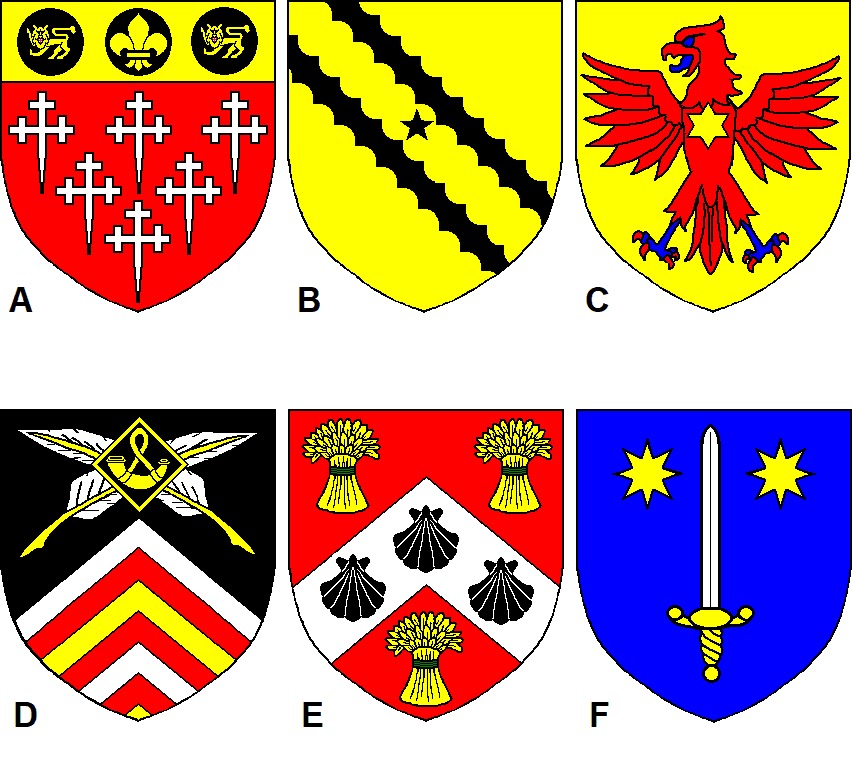
A)
Charles Adams
(1770-1800); arms inherited from his father, US President John Adams, who
assumed them in 1783. The President believed that English heraldic rules didn’t
apply in the US after independence and, because his father’s family had no coat
of arms, Adams assumed those of his mother’s, to which he added a fleur-de-lys
and lions to the black discs. B)
Mary Blathwayt (1879-1961),
suffragette; family arms bearing the cadency mark of a third son (star) as
borne by her grandfather. The family arms were first recorded in 1690 for
Mary’s ancestor William Blathwayt, MP. C)
Olive Custance (1874-1944),
poet; inherited family arms, probably first used by her ancestor Hambleton
Custance (d.1757). After several lesbian affairs Olive married Lord Alfred
Douglas, Oscar Wilde’s old boyfriend, after which she could display her arms on
a small shield in the middle of his (as her father’s only child and heraldic
heir). Their children could, consequently, place the Custance arms as a quarter
on their arms. D)
Natalie de Clare, Countess of Markland (b.1975); personal arms registered by the South
African Bureau of Heraldry in 2016. The design incorporates the red chevrons of
the medieval de Clare family from whom the countess descends. E)
Nicholas Eden, 2nd Earl of Avon (1930-1985), government minister; family arms inherited from his
father, former Prime Minister Sir Anthony Eden, 1st Earl of Avon. These arms
have been used by the Eden family since the 1600s. F)
Marsilio Ficino (1433-1499),
philosopher; probably assumed arms. I’ve only recently begun to research these
arms. Ficino drew them on a manuscript dated 1455. The arms of his pupil’s
family, Francesco Cattari da Diaceto, differ only in the substitution of a
white stripe for the sword. It is unclear if Ficino assumed his similar design
as the Cattari family or was influenced by it.
G)
Lady Anne Gordon (b.1988),
daughter of the Marquess of Aberdeen; family arms of her father and direct male
ancestors back to the 17th century. Being Scottish arms Lady Anne would need to
matriculate her own distinctive version. H)
Jennifer Hilton, Baroness Hilton of Eggardon (b.1936); personal grant. See here. I)
Sir Charles Irving (1924-1996),
MP; arms of office, being those of the borough of Cheltenham granted by the
College of Arms in 1877. Sir Charles could assume these arms during his two
terms of office as mayor. He was granted personal arms in 1991 which I have not
yet researched. J)
Greville Janner, Baron Janner of Braunstone (1928-2015), ex-MP; personal arms granted by the
College of Arms in 1997. Green and red represent the Houses of Commons and
Lords respectively. K)
Capt. Martin Oranmore Kirwan (1847-1904), 5th Battalion, Royal Dublin Fusiliers; inherited family
arms, Capt. Kirwan was heir to Cregg Castle, Co. Galway. L)
Most Rev. Roger LaRade,
Primate Archbishop of the Eucharistic Catholic Church (ECC) in Canada; personal
arms of office as authorised by the ECC. The arms of the ECC appear at the top
of the shield. The Archbishop’s personal arms, assumed following his
appointment as archbishop in 2005, are beneath.
M)
Violet Martin (1862-1915),
writer; inherited family arms. The date of origin is uncertain, but Dublin
Castle archives record the family legend of Richard the Lionheart granting
these arms in the 1190s to the Crusader knight Sir Oliver Martin, the supposed
ancestor of the family. The arms were later confirmed to the family by the
Office of Ulster King of Arms. N)
Sir Isaac Newton (1642-1727),
scientist; inherited family arms, originally assumed, with permission given by
the College of Arms in 1634. They were used by various Newton families since
the 15th century. O)
Charles George Oates (1844-1902),
barrister; personal arms, being the inherited family arms of his father with
Charles’ cadency mark as a third surviving son (a star). P)
Richard Püller von Hohenburg (d.1482),
knight (to be featured in a future “80 Gays” article); inherited family arms,
used by his paternal ancestors since before 1300. Q)
Lt. Cmdr. Michael J. Quigley (b.1970),
US Navy, Counter-terrorism officer; personal honorary grant from the College of
Arms in 2012. Based on the arms of the Quigleys of County Donegal. R)
Hon. Nancy Ruth (b.1942),
Canadian Senator 2005-17; inherited family arms, being those granted by the
College of Arms to her father in 1955. (Note: Nancy Ruth does not
use her family name but prefers to be known by her first names together. This
means she should really be placed under “N”. I placed her arms under “R” because
I had already chosen who to place under “N”, and had no-one for “R”.)
S)
Winnaretta Singer, Princess Edmond de Polignac (1865-1943), marital arms, being those of her
husband Prince Edmond. The quarters represent the families of de Polignac (top
left), Parkyns of Bunny Hall Nottinghamshire (top right, bottom left), and
Middlemore of Lusby (bottom right). T)
Jaci Taylor (b.1945),
Mayor of Aberystwyth 2000-1; arms of office, being the arms granted to the
borough of Aberystwyth by the College of Arms in 1961 and transferred to the
town council in 1975. Jaci could assume these arms during her term of office. V)
Ole von Beust (b.1955),
President of the German Bundesrat 2007-8 (to be featured in a future “80 Gays”
article); inherited family arms dating from before 1300. W)
Horace Walpole (1717-1797),
writer, 4th Earl of Orford; inherited family arms. Until he inherited the title
in 1791 Horace would have used his cadency mark of a third son (a star).
Walpole featured in an “80 Gays” article earlier this year. Y)
Will Young (b.1979),
singer and actor; family arms as suggested by Jeffrey Poole in “An Illustrated
General Armory of South Australia”. Poole lists these arms as those of Sir Henry
Young (1803-1870), Governor of Tasmania, Will’s ancestor. They are also the
arms of the baronets of North Dean, Buckinghamshire, though I have yet to
establish a precise family relationship. Z)
St. Zosima of Siberia (1767-1833),
monk and Russian Orthodox saint; probable inherited family arms, being those of
the family of Verkhovsky of Kostroma in Russia to which the saint belonged.